
Harry Geels: Market power of the ultra-wealthy is part of the stability issue

By Harry Geels
The Wall Street Journal (WSJ) recently published an article about a growing group of wealthy individuals in the US who are responsible for the lion’s share of economic growth. Four interesting conclusions can be drawn from this.
According to the article, the number of Americans with eight- or nine-figure fortunes has risen sharply in recent years, largely thanks to strong economic growth, rising stock markets, private equity and property. This group has grown far beyond just billionaires and ultra-famous figures: it comprises entrepreneurs, investors and top executives of major companies who remain out of the spotlight, yet now play a disproportionately large economic role.
The consumption and investment behaviour of these ultra-high-net-worth individuals, ranging from luxury homes and private education to businesses and services, has a visible impact on growth, jobs and local economies. As a result, an ever-increasing proportion of US economic dynamism has become dependent on a relatively small, wealthy elite: a shift with far-reaching consequences for both inequality and economic stability. There are roughly four striking conclusions.
1) Disproportionate influence on the economy
The highest income groups, particularly the top 10%, now account for almost half of all consumer spending in the US. Because they earn well, they have few constraints on their spending. They do not keep a household budget, and their expenditure on luxury travel, homes, private education, healthcare and local leisure services keeps the economy going. They thus form a stark contrast to middle and lower-income earners, who have far less to spend or need to watch their pennies more closely.
2) A two-speed economy
The WSJ outlines an increasingly clear K-shaped economy: at the top, prosperity and consumption continue to grow, whilst at the bottom, purchasing power remains under pressure from inflation, higher interest rates and limited wage growth. The K-shaped dynamic became apparent after Covid, but is proving persistent. We are seeing a permanent divergence (in contrast to the neoliberalism of the 1980s and 1990s: that initially also led to a K-economy, from which almost everyone benefited fairly quickly).
3) Consequences for businesses and cities
A third observation is that businesses are adapting their strategies by targeting these affluent customers (for example, in luxury goods, healthcare and services). This is also changing local economies: certain neighbourhoods, schools and services are flourishing, whilst others are lagging behind due to a lack of wealthy residents. We see that properties near good schools are becoming more expensive relatively faster. We also see that in major cities, modern office centres, luxury homes and entertainment are merging to form fashionable, exclusive neighbourhoods.
4) Vulnerability of this model
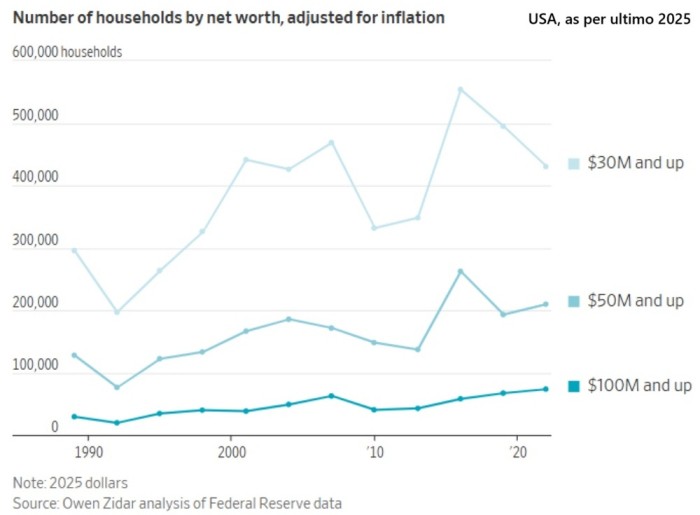
The WSJ rightly emphasises that this dependence on wealthy consumers makes the economy more vulnerable: if stock or property markets fall and this group spends less, this can have major consequences for growth and employment. The chart below shows relatively high volatility in the wealth of three groups of high-net-worth individuals, caused by price movements in ‘assets’. This dependence on the stock markets makes the economy more susceptible to ‘animal spirits’.
Does Europe also have a K-shaped economy?
Complementing the WSJ analysis is the question of whether the K-shaped economy is also a phenomenon in Europe. The short answer is ‘yes’, although the percentages differ and there are, of course, variations between countries. We do not see the extreme ratio here where roughly 10% of the highest earners account for nearly 50% of all private spending. Moreover, the social safety nets and redistribution mechanisms (via taxation) are more extensive here. In short: it is not a uniform picture, but the trend is similar.
To trickle down or not to trickle down?
Another related question is whether there is a trickle-down effect. When the (ultra-)wealthy spend their money, do restaurants, theme parks or hotels — including their staff — also benefit? That could offer some relief from the alleged inequality. The point is that the trickle-down effect does indeed exist, but is partly negated by other forces, such as the market power of oligopolistic firms and monetary, banking and government policy.
The implicit direction of the WSJ
It is striking that the WSJ, entirely in keeping with its tradition, adopts a primarily diagnostic stance. Yet the implicit message is clear: an economy that increasingly relies on the spending and investment of the upper echelons of the population becomes more vulnerable and procyclical. Less dispersed purchasing power means less cushioning against shocks, whilst dependence on financial markets increases. The K-shaped economy is not so much a question of inequality, but primarily a question of stability.
A clearer path to a solution
More specifically – for the 90% with less wealth – excessive market power should be curbed and monetary, banking and credit policies should become more inclusive (for example, less emphasis on asset inflation). Not to discourage wealth creation, but to ensure that economic dynamism is once again based more on larger groups of workers and entrepreneurship and less on fluctuations in financial values. Not levelling down, then, but a broader and more stable basis for growth and participation.
This article contains the personal opinion of Harry Geels