
MFS: Navigating ESG risk and uncertainty in EMD

Understanding how material ESG factors influence credit risk is a key aspect of navigating uncertainty and opportunity in emerging market debt investing.
By Pelumi Olawale, Katrina Uzun and Aimee Kaye
Emerging markets play an increasingly important role in global portfolios, offering both diversification and long‑term growth potential. However, investors in EMD must also contend with heightened sensitivity to ESG risks. Climate vulnerability, social stability, institutional quality and governance standards can all materially affect an issuer’s creditworthiness and long‑term debt durability.
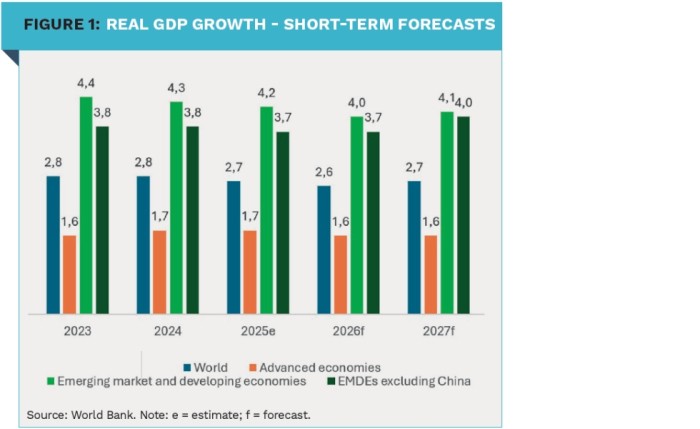
Economic short-term forecasts underscore the relevance of emerging markets in a global context. While growth in advanced economies remains subdued, developing economies are expected to grow steadily over the medium term. This growth dynamic reinforces the strategic importance of emerging markets for long‑term investors but also amplifies the need for effective risk assessment frameworks that extend beyond traditional financial metrics.
ESG factors as leading indicators of credit risk
A growing body of research indicates that ESG factors can often signal the creditworthiness of emerging market issuers. Physical climate risk, natural resource management, social cohesion, education outcomes, income inequality, rule of law, labour rights and institutional accountability can all influence an issuer’s financial probability of default and the trajectory of credit spreads over time.
However, not all ESG factors are equally relevant for every issuer. Materiality is central to effective ESG integration. For sovereign issuers, governance quality has historically been the most influential pillar, reflecting its impact on fiscal discipline, policy continuity and institutional resilience. Social factors such as health, education and labour participation also play a critical role, particularly in economies undergoing demographic transition. Environmental factors, while historically less prominent in credit analysis, are gaining importance as climate risks become more immediate and measurable.
Modelling material ESG risks
To assess these dynamics systematically, ESG data can be analysed alongside traditional financial indicators to provide a more complete view of issuer risk. Rather than relying on static or equal‑weighted ESG scores, a more nuanced approach considers how the relevance of each ESG factor evolves over time and across countries.
Trend analysis and peer comparisons help investors assess whether an issuer’s ESG performance is improving or deteriorating relative to its economic and regional peers. Changes in directionality — for example, improving governance standards or worsening climate exposure — may offer early signals of future credit re‑rating, either positive or negative.
Importantly, ESG data remains imperfect. Available datasets may be incomplete, backward‑looking, or inconsistent across sources. As a result, quantitative analyses should be complemented by qualitative assessments and ongoing monitoring. Our ESG dashboard allows our analysts and portfolio managers to understand material risks and opportunities beyond financial reports. We compile ESG data from sources with breadth and depth across emerging markets.
Engagement as a risk‑management tool
Engaging with issuers is an important component of ESG‑informed credit analysis, particularly in emerging markets where public disclosure may be limited. Speaking with policymakers, regulators, corporate leaders, and other stakeholders can enhance investors’ understanding of reform momentum, policy credibility and longer‑term strategic priorities. Our emerging market debt portfolio managers and credit analysts typically meet with government officials, company executives, opposition politicians, economists, academics, journalists and consultants several times each year. These meetings are intended to deepen our understanding of issuers and the material factors affecting them.
Navigating the energy transition in emerging markets
The global energy transition presents both risks and opportunities for emerging market debt investors. Emerging economies face the complex challenge of balancing economic development, access to affordable energy, and emissions reduction. Many remain heavily dependent on fossil fuels for growth, employment, and fiscal revenue.
Transitioning to more sustainable energy sources requires substantial capital expenditure. Investment in renewable energy and energy efficiency infrastructure can place pressure on public finances, particularly when such projects rely on borrowed foreign currency. Investors must therefore assess the impact of transition financing on issuers’ balance sheets and creditworthiness. Foreigncurrency borrowing without long-term local monetary or fiscal policy alignment should raise concerns.
Stranded assets are another critical consideration. As the cost of renewable energy continues to decline, longstanding investments in fossil fuels may become economically unviable earlier than anticipated. This risk is particularly relevant where transition pathways rely on interim solutions with long asset lifespans.
Social factors are equally important. The transition to a lower‑carbon economy, while creating job opportunities in new industries, could also disrupt employment in critical economic sectors, including agriculture, manufacturing, and transport. Understanding how governments plan to manage labour dislocation, retraining, and social protection is essential to evaluating a country’s political and social stability.
Climate resilience and adaptation also warrant close attention. Many emerging markets are disproportionately exposed to extreme weather, water scarcity and agricultural disruption. It is therefore essential to assess an issuer’s climate resilience measures, adaptation strategies and investments in climate-friendly technologies. Monitoring green bond issuance and how proceeds are used could provide insights into countries’ ability to attract capital for climate change mitigation projects.
Case study: Morocco
This case study illustrates how we incorporated ESG factors when assessing Morocco’s sovereign debt. The country faces significant environmental risks, including drought exposure and dependence on imported energy and food. At the same time, it has made meaningful progress in addressing structural challenges in health care, education and renewable energy.
Relative political stability and institutional strength have supported policy implementation and reform momentum. Together, these factors contribute to a more resilient credit profile and highlight how improvements in ESG performance and close engagement with issuers can increase valuation.
Conclusion
Investing in emerging market debt requires navigating complexity across economic, political and sustainability dimensions. ESG factors can offer valuable insights into long‑term risk and opportunity when assessed through a financial materialityfocused, forward‑looking lens.
By combining quantitative analysis with qualitative assessments and active engagement, investors can better identify vulnerabilities and potential inflection points in issuer credit profiles. As ESG challenges continue to evolve, integrating these considerations will remain a key aspect to managing risk and uncertainty in emerging market debt.
|
SUMMARY Investors in emerging markets face significant ESG-related risks affecting creditworthiness, but stronger growth prospects than advanced economies reinforce their strategic importance for portfolios. ESG factors, especially governance, can signal default risk and future credit developments. Effective analysis requires focusing on material ESG factors, supported by both data and qualitative insights. Active engagement with issuers improves understanding of risks and reform momentum. The energy transition introduces financial, social and environmental risks that must be carefully assessed. |
Read the full article in Financial Investigator magazine