
Evergreen funds stand the test in a turbulent private debt market
This report was originally written in Dutch. This is an English translation.
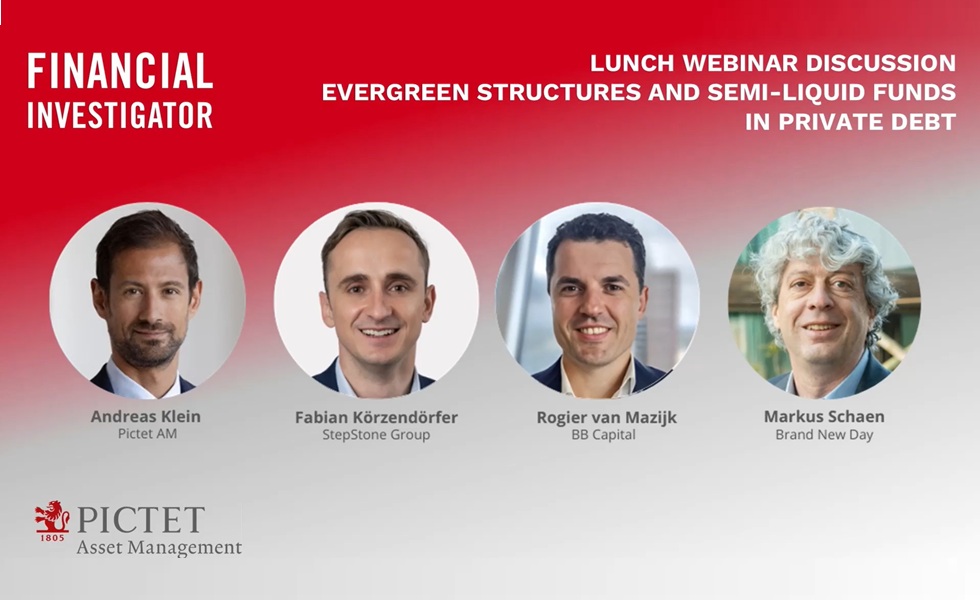
The global private debt market has grown significantly. Dutch pension funds have also substantially increased their exposure. Does the asset class retain its appeal under the WTP? And which risks are still often underestimated? During a lunch webinar discussion organised by Financial Investigator and led by Harry Geels, three experts discuss what pension funds need to bear in mind when considering investing in private debt.
By Esther Waal
|
Chair: Markus Schaen, Brand New Day Participants: Andreas Klein, Pictet Asset Management Fabian Körzendörfer, StepStone Group Rogier van Mazijk, BB Capital Investments |
Markus Schaen notes at the outset that the timing of the webinar is ideal. ‘Private debt is very much in the news. We are reading about high numbers of redemption requests, funds applying gating, and fears of defaults in certain sectors. What is going on?’
According to Andreas Klein, the turmoil is a ‘combination of events’. ‘It began last year with the default of property firm Signa and a few other companies, such as First Brands and Tricolor. The uncertainty surrounding the impact of AI also plays a role, particularly where exposure to software is concerned. Then came the revaluations, where we saw some major BDCs in the US implementing significant write-downs. All in all, this created fear and some investors began selling their positions in BDCs, which led to concerns about liquidity. Fear feeds on fear, which reinforced that behaviour. But the underlying credit fundamentals are very different from the picture painted in the media.’
Fabian Körzendörfer adds: ‘Agreed. The asset class continues to perform well. Default rates remain low and the so-called shadow default rate has also fallen recently. This has led to increased interest among institutional investors in private credit in recent weeks. They realise that the current turmoil can present attractive opportunities.’
Rogier van Mazijk responds: ‘What was previously seen as an exclusive advantage is now framed as a systemic risk. We are now hearing a narrative of hidden defaults, and that risks are supposedly accumulating out of sight of regulators.’
‘To what extent is the current turmoil cyclical or structural in nature?’ asks Schaen. According to Van Mazijk, it is likely a combination of both. ‘There are cyclical factors – such as competition, margins and interest rates – but there is also a structural shift taking place in the investor base. The emergence of BDCs and evergreen structures has brought non-institutional investors into the market. And sentiment plays a major role there.’
Körzendörfer adds a nuance: ‘The wealth management segment is relatively small compared to the total size of the asset class. Moreover, not everyone within this segment is reducing their position. Redemption requests are usually between 5 and 10 per cent, which is higher than usual, but still limited in relation to the size of the asset class. The media are blowing this out of proportion. But it could also turn out positively. Less inflow into evergreen funds could lead to better market conditions.’
Klein adds that he sees this period as a test for evergreen structures. ‘Contrary to what the negative headlines suggest, I see the funds doing exactly what they were designed to do. The structures offer “contractual” liquidity, but also continue to protect the interests of remaining investors, which is crucial.’
Rise of evergreens
When Schaen asks how the market for evergreens has developed, Klein explains that the private credit market grew at an unprecedented rate following the financial crisis. ‘It filled the liquidity gap left by the banks. At a certain point, however, a mismatch arose between supply and demand, and the risk-return ratio was diluted. In addition, Covid and the new interest rate regime caused capital flows back to investors to slow down, which has limited new fund raising and prompted GPs to look for alternatives. As a result, evergreen structures have emerged to gain greater access to the wealth management segment.’
Körzendörfer adds: ‘Subscription-based evergreen funds operate with a continuous inflow: they typically accept monthly and sometimes even weekly deposits. The money is invested from day one and they offer liquidity – usually around 5% per quarter. The biggest advantage – for every type of investor – is that your money is invested immediately and that you have flexibility. With closed-end funds, the investment period was historically three to four years, with a maximum investment level of 70% to 80%. That maximises the absolute return. Semi-liquid funds also solve an operational problem: capital calls disappear.
Schaen then zooms in on the flip side and asks about the disadvantages. Van Mazijk first mentions the liquidity aspect. ‘You always have a portion of the portfolio in liquid assets, and investors pay for that. The more liquidity, the greater the cash drag, and thus the lower the return.’ ‘And evergreen structures are usually not the most adaptable structures,’ adds Körzendörfer. ‘It is a one-size-fits-all product. For large institutional investors with very specific requirements, a mixed evergreen fund may not be the right solution.’
Klein adds another point to consider: ‘Because you are fully invested from day one, the GP must ensure that not too many subscriptions are accepted. This can put pressure on underwriting discipline, as you may be forced to invest quickly. Another disadvantage is the risk of correlated investor behaviour if the investor base is not well diversified. ’
When Schaen asks about the differences between closed-end and evergreen structures, Körzendörfer sees the liquidity buffer as the key difference. ‘But,’ he notes, ‘research shows that the IRR difference between evergreen and closed-end direct lending is small, as an evergreen fund is fully invested from day one. In absolute return terms, evergreen can therefore actually perform better.’ ‘Certainly for non-institutional investors,’ adds Van Mazijk. ‘For them, it’s almost a no-brainer.’
Schaen turns the conversation to manager selection: ‘What should you look out for when selecting an evergreen fund?’ Van Mazijk has experience.
‘On the surface, everything looks the same. So you have to dig deeper and look at governance and liquidity management.
What exactly is in the liquidity buffer? Is it just cash, or also liquid loans? How is liquidity released when necessary?’ Körzendörfer mentions selectivity, diversification and flexibility. ‘Diversification is crucial, and fees are also important. The difference between a good evergreen fund and a closed-end fund shouldn’t be huge, even though managing an evergreen fund is more expensive.’
Opportunities for alpha in the lower mid-market
Then it’s time to delve deeper into the direct lending market. ‘What does that look like?’ asks Schaen. Körzendörfer explains: ‘Put simply, you can divide direct lending along two axes. We define companies with less than 25 million in EBITDA as lower mid-market, 25 to 75 million as mid-market and 75 to around 200 million as upper mid-market. There is also the ownership structure: sponsored versus non-sponsored. So companies owned by private equity versus companies owned by families or entrepreneurs.’
Klein currently sees the most opportunities in the lower mid-market and non-sponsored segments, partly due to the massive wave of consolidation. ‘In 2024 and 2025, around 90% of the fundraising volume went to about ten GPs. This created a barbell effect: on the one hand, very large GPs with funds of 10 billion or more serving the mid- and upper-mid-market, and on the other hand, smaller niche players focusing on the lower mid-market or specific sectors. If you want real diversification and alpha, you need to look at niche managers: sector specialists, geographical specialists, and non-sponsored lending in particular is interesting. The risk-return profile is often better there, with lower leverage, better covenant protection and higher yields. So in the lower mid-market, I see plenty of opportunities for alpha.’
Klein does, however, highlight areas of concern, such as consumer-oriented sectors, geopolitical risks, the oil price and interest rates. ‘If tensions escalate further, we will adopt a defensive stance. But at the moment, the fundamentals are strong and we are positive about the asset class.’
The other panellists agree. Körzendörfer: ‘There are always risks, but the recent turmoil can actually create opportunities.’
|
SUMMARY The turbulence in the private debt market is due to defaults, revaluations and market sentiment, but the fundamentals remain strong. Despite higher redemption requests, evergreen structures provide liquidity and protect long-term investors. Evergreen funds offer flexibility and direct investment, but incur liquidity costs and face limitations in terms of customisation. The differences with closed-end funds are limited, but the returns are comparable. Opportunities lie mainly in niche markets, particularly in the lower mid-market and non-sponsored lending. |
Read the full report in Financial Investigator magazine