
DMFCO AM: Harnessing surplus value is becoming a growth market

This interview was originally written in Dutch. This is an English translation
An increasing number of older homeowners are looking for ways to tap into the equity in their homes. The Dutch market for equity release loans therefore appears to be on the cusp of a period of sustained growth. According to Edo van de Burgwal of DMFCO Asset Management, institutional investors could play a key role.
By our editorial team
It is estimated that around €450 billion in equity is ‘locked up’ among people aged 67 and over in the Netherlands. In the US and the UK, equity release products are already quite well developed, whereas the range of options in the Netherlands is still limited. How do you explain this difference?
‘There are good historical reasons for this. The Dutch are more reluctant to take on debt than the British or Americans. In addition, the Netherlands has a comprehensive state pension and private pension system. Furthermore, until recently, pensioners here could easily tap into their equity via a standard interest-only mortgage, an option that does not exist in other countries. As a result, the Dutch market for specialised equity release products has remained limited to people without sufficient income.
That situation is now changing significantly. An ageing population and rising equity are creating a growing need to unlock home equity in different ways. The market now offers various product types: from mortgages with monthly interest payments to products where interest is capitalised or a share of the property is transferred.’
You expect the market for equity release products to grow structurally. What is that based on?
‘There are several developments that reinforce one another. Statistics Netherlands (CBS) expects a 50% increase in the number of pensioners over the next twenty years. Rising house prices and the focus on capital repayment are further increasing equity. The new pension system makes pension income more variable, which increases the need for financial security.
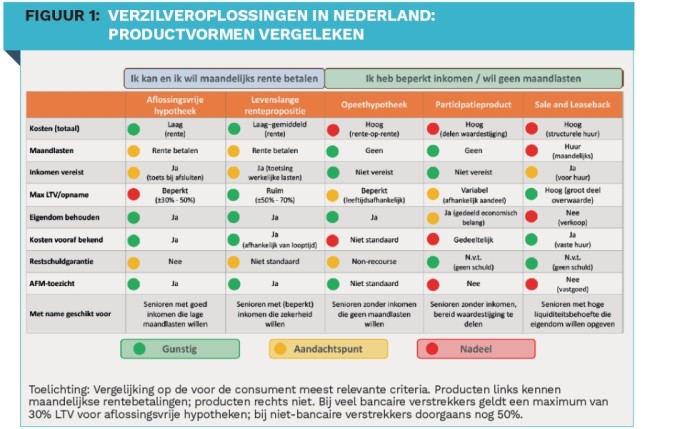
At the same time, the most common route is narrowing. Under pressure from regulators, major banks are reducing the maximum interest-only portion from 50% to 30% of the property value. Pensioners who wish to withdraw more are no longer eligible at their bank. That is a structural policy change.
The result is a double bind: homeowners are obliged to repay their mortgages on an annuity basis and are therefore accumulating increasing equity in their homes, whilst major banks are actually restricting the ability to release that equity via standard mortgages. Due to the combination of growing demand and shrinking banking supply, this segment is shifting from a niche to a structurally growing segment within the mortgage market.’
Pension funds and insurers have extensive experience investing in Dutch mortgages. Why are these parties particularly well-positioned to meet the growing demand for liquidity? And what makes these loans attractive as a supplement within an existing mortgage or fixed-income portfolio?
‘Institutional investors are not subject to the portfolio restrictions that force banks to reduce their interest-only portfolios. Their long investment horizon aligns well with the term of this type of loan, comparable to a 15- to 20-year fixed-rate mortgage. That profile is becoming increasingly scarce in the portfolios of investors with long-term liabilities, and a cash-out loan offers an attractive spread.
For products with a lifetime fixed interest rate and monthly interest payments, the risk profile is conservative and comparable to a standard mortgage investment.
There is also a social dimension to this: these investments enable pensioners to live independently in their own homes for longer. Pension funds manage the assets of precisely the generation that currently needs this. That direct link with their own target group also makes this segment relevant from the social perspective of responsible investment.’
Reverse mortgages differ from standard mortgages in several respects. What specific risks are involved here, and to what extent can these be properly analysed and managed by institutional investors?
‘Compared to a standard mortgage, this type of loan has a more favourable risk profile in one key respect: there is no refinancing risk. The lifetime fixed interest rate completely eliminates the interest rate reset risk, for both the consumer and the investor. The most distinctive risk is repayment behaviour. Whereas with standard mortgages, early repayment is driven by interest rate movements, here it is driven by life events. This makes cash flows less interest-rate sensitive and therefore more predictable. The structural nature of state pension and occupational pension income ensures that monthly payments remain affordable throughout the entire term. For investors with experience in Dutch mortgages, this risk profile is therefore easily recognisable. The Dutch housing market is transparent, mortality statistics are reliable and repayment behaviour can be accurately estimated on an actuarial basis. In short: very similar to an investment in a standard Dutch mortgage.’
There are now various types of reverse mortgage products on the market. Which product type has the most potential?
‘In our view, products with a lifetime fixed interest rate have the most potential. The consumer pays monthly interest and repays the loan upon sale or death: predictable costs, no refinancing risk and full retention of ownership.
For most pensioners, this is also the cheapest and easiest-to-understand solution, as the product is fundamentally similar to a standard mortgage. The risk profile for investors is therefore in line with this: conservative LTVs, strong collateral values and predictable cash flows. That said, where inheritance is not a priority and there is a lack of income, a ‘eat-away’ mortgage can work well. The compound interest effect is attractive from an investor’s perspective, but at the same time makes the product costly for the consumer. Participation products are conceptually simple, but the costs cannot be determined in advance. The central question for every product type is how consumer interests and returns relate to one another. With lifetime annuity products, that balance is most convincing: transparent for the consumer, predictable for the investor.’
What are the key conditions for a well-functioning retirement savings market? And what role do providers, investors and, where applicable, policymakers play in this?
‘A well-functioning market requires three conditions. Firstly, products that consumers understand. The target group is characterised by limited financial flexibility and potentially changing cognitive abilities. Simplicity and transparency are therefore essential. Secondly, providers must take the social element seriously. Product terms must adapt to changing life circumstances: the death of a partner, moving into a care home, or the need for home adaptations. Pension funds are ideally placed to handle this responsibly.
Thirdly, policymakers can strengthen the market. The coalition agreement of January 2026 announces a ‘step-down mortgage’ to encourage older people to move to a smaller home. This is a welcome step, but many older people actually want to remain in their familiar home and create financial breathing space there. For this group, the move-on mortgage offers no solution. Lenders can already serve this group. Nevertheless, the government can make a difference here by creating the framework conditions under which the market can develop broadly and responsibly.’
|
SUMMARY There is €450 billion in equity ‘locked up’ among the over-67s, but specialised equity release products are scarce. Major banks are limiting interest-only mortgages to 30% LTV, which creates scope for non-bank lenders. Lifetime interest rate propositions offer the best balance between consumer interests and investor returns. Home equity loans combine a long investment horizon with a direct social impact: enabling pensioners to live independently in their own homes for longer. The market is growing structurally, driven by an ageing population and a double bind of mandatory repayments and a shrinking banking supply. |
Read the interview in the digital magazine