
The practice of local impact investing (part 2 of the ‘Local Impact’ round table)
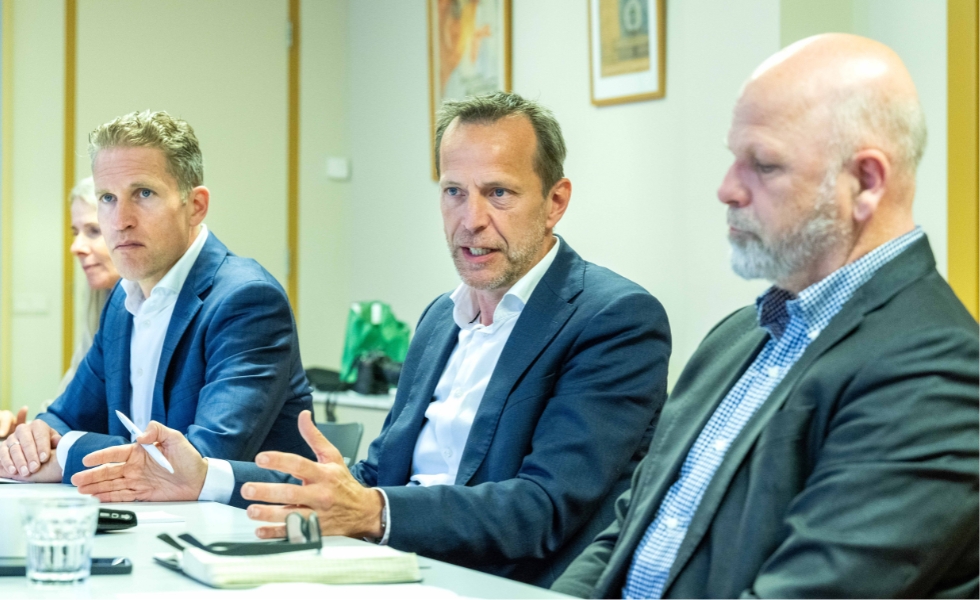
This report was originally written in Dutch. This is an English translation
Interest in local impact investing is clearly growing amongst pension funds. During the Financial Investigator round-table discussion on this topic, it emerged that an increasing number of funds recognise the social added value of these investments.
By Baart Koster
This is part 2 of the round-table report. Part 1 was published previously
|
CHAIR: Marlene Stam, Collective Action
PARTICIPANTS: Jorrit Arissen, Van Lanschot Kempen Vincent van Bijleveld, GREEN, Finance Ideas Bob Crans, Montae & Partners Ronald van Dijk, Rail & Public Transport Pension Fund Fabio Rodrigues dos Santos, Eiffel Investment Group Hans de Ruiter, TNO Pension Fund |
Strengthen the chain
From this point, the discussion shifts from vision to implementation. Because if pension funds genuinely want to scale up local impact investing, how do you organise that in practice? That is precisely where the complexity seems to begin. Collaboration sounds logical, but who takes the initiative? Who organises the governance? And how do you prevent each party from having to set up the infrastructure, expertise and assessment frameworks from scratch all over again? Van Dijk advocates a stronger financial ecosystem in which pension funds, venture capital firms, fiduciaries and asset managers work together. In his view, local impact investing is not just about capital, but also about the capacity to properly assess and support companies. ‘You need people who can screen, analyse and support such companies,’ he says. ‘That requires capacity, knowledge and organisation.’
De Ruiter therefore sees great value in strategic partnerships. In his view, the biggest challenge lies not so much in funding, but in organisational strength and execution. The TNO pension fund therefore deliberately collaborates with specialist firms in private equity and venture capital, precisely because not every fund can build up all the necessary expertise in-house. He believes there is generally a willingness to collaborate within the sector, but organising such collaboration often proves difficult in practice. According to De Ruiter, you run into questions such as: who takes the initiative, who is in charge, and how do you ensure that collaboration actually leads to implementation? Crans notes that smaller pension funds in particular regularly struggle with translating ambition into concrete implementation. Boards are keen to take steps towards impact investing, but do not always have sufficient capacity or specialist knowledge to assess complex private markets independently. According to Crans, impact investing in private markets requires not only ambition, but also sufficient knowledge, capacity and time within the organisation. He believes that smaller funds, in particular, regularly run into this problem.
This explains the general perception that local impact investing often takes a long time to get off the ground. Whilst interest is clearly growing, the capacity to implement it does not always keep pace. Another factor is that many pension funds have been heavily occupied in recent years by the transition to the new pension system. Crans therefore expects the discussion on local impact investing to gather momentum in the coming years. ‘The fact that many funds are still postponing local impact investing is not because they do not want to, but simply because they do not have the time for it at the moment,’ says Crans.
Additionality makes the difference
A key topic of discussion is whether impact investing should actually still be regarded as a separate asset class. According to several participants, impact is shifting ever more emphatically towards mainstream portfolio construction. Van Dijk sees a clear trend in this. ‘Ten years ago, pension funds were still experimenting with separate impact mandates,’ he says. ‘Now you see much more often that impact is simply organised within existing asset classes.’ By this he means categories such as infrastructure, private credit and private equity, within which pension funds then seek to make specific impact choices. According to Van Dijk, this also aligns more closely with the way in which pension funds traditionally build portfolios.
De Ruiter recognises this trend. In his view, pension funds are increasingly seeking to integrate impact within existing investment structures rather than setting up separate impact categories. ‘We’re already heavily involved in venture capital and private credit anyway,’ he says. ‘Then you start looking at where you can make an impact within that.’ However, this view is not universally shared. Van Bijleveld emphasises that research carried out by Finance Ideas shows that a significant proportion of pension funds are willing to consider (small) allocations to new asset categories precisely because of economic or sustainability-related real-world impact objectives. He was particularly pleasantly surprised by the recognition amongst pension funds that venture capital can have a significant impact and therefore warrants further investigation. ‘Venture capital can deliver excellent returns. The experiences of the TNO Pension Fund demonstrate this. Large allocations aren’t necessary, and governance requires commitment. But it is precisely the willingness to take that step that enables you to make a real impact here.’
Our research shows that not everything that sounds ‘green’ actually leads to change. That is precisely why a clear theory of change is so important.
This highlights a difference in approach during the round-table discussion. On the one hand, there is a conviction that impact should be integrated into existing portfolios as much as possible. On the other hand, there is also the view that separate impact allocations can provide scope for investments that would otherwise never get off the ground. Van Bijleveld emphasises that the amounts required are often relatively modest. In his view, only a small proportion of total pension assets needs to be channelled into venture capital or innovative growth financing to have a visible economic impact. ‘If all Dutch pension funds were to allocate half a per cent of their assets to venture capital, that would already give that market a huge boost,’ he says.
Data, measurability and frustration
Whenever impact investing is discussed, the debate about measurability almost automatically follows. How do you actually demonstrate that an investment has a genuine social impact? Opinions on this matter at the table appear to diverge markedly. De Ruiter cites data infrastructure as a major bottleneck, particularly for start-ups and scale-ups.
Large listed companies generally have comprehensive reporting systems, but young growth companies are often far less advanced in this respect. ‘Ultimately, you do want to be able to show something,’ says De Ruiter. ‘If you claim that something has an impact, you need to be able to substantiate that to some extent.’ Dos Santos also recognises this problem in the practice of private credit. With some investments, that impact is relatively easy to see, for example in energy storage, offshore wind or solar energy. However, according to Dos Santos, the situation is more complicated when it comes to social impact themes. ‘That is why, together with an external partner, we developed an analysis tool based on CBS data and demographic information. We are using this to try to make the social effects that investments can have at a local level more visible.’
According to Dos Santos, this not only helps to make impact more measurable, but also to gain a clearer insight into where social interventions have the greatest effect locally. It is precisely with social impact themes that regional context makes a significant difference, says Dos Santos. He cites investments in labour market participation as an example. When companies help people who are distanced from the labour market to find work, the social impact of this can vary greatly from region to region. ‘If you do something like that in an area where unemployment is already low, it has a different impact than in a region where that problem is much greater,’ says Dos Santos.
Does impact need to be measurable?
During the discussion, scepticism is voiced about the ever-increasing emphasis on measurability. Van Dijk, in particular, raises serious questions about the way in which impact is sometimes approached in practice. ‘The impact sector constantly insists that everything must be measurable, but I wonder whether that is always necessary.’ According to Van Dijk, impact measurement sometimes risks becoming an end in itself, whilst the costs and administrative burdens rise sharply as a result. Moreover, he believes there is a risk that investors will focus primarily on reporting rather than on actual social change. ‘If something quacks like a duck and walks like a duck, then perhaps it’s just a duck,’ he says. In other words, some investments are so obviously socially relevant that endless measurement models add little value. According to Van Dijk, it ultimately comes down to being able to explain things to participants and the board.
Pension funds often harbour a fear nonetheless: what if this ends up on the front page of the FD?
Van Bijleveld takes a middle ground. In his view, impact does not always need to be fully quantifiable – an initial proof of concept is likely to save less CO2 than the thousandth solar park – but there must be trust in the process and in the way the manager assesses the impact of investments. ‘There does need to be a well-founded Theory of Change: which problem is being tackled and to what extent does this investment solve it? Our research shows that not everything that sounds green actually leads to change. That is precisely why a clear Theory of Change is so important,’ he says. Crans also observes that many pension funds are struggling with the increasing complexity of impact definitions and reporting requirements.
In his view, an overly strict approach can actually be paralysing. ‘Some boards simply want to invest in companies they feel are socially relevant,’ he says. ‘In that case, you don’t want to get bogged down first in a huge debate about definitions.’ This tension between pragmatism and measurability runs like a common thread through the discussion. No one at the table advocates making non-binding claims about impact, but at the same time, there is also a warning that impact investing must not become bogged down in bureaucracy.
|
Marlene Stam Marlene Stam has been focusing on impact investing since 2010 and uses her in-depth knowledge in this field to accelerate the transition to a sustainable financial system. She is currently a Partner at Collective Action and a member of the Investment Committee at Planet&People One. Previously, she held positions at companies including Russell Investments, XS Investments and Twelve Capital. |
|
Jorrit Arissen Jorrit Arissen has been with Van Lanschot Kempen since 2015, where, as Co-Head of Alternative Manager Research, he advises institutional clients on strategic allocations within private markets. In recent years, he has pioneered innovative, locally rooted impact solutions for sectors including property and private debt. Arissen has over twenty years’ experience and previously worked at PGGM Investments and APG Asset Management. |

|
Vincent van Bijleveld Vincent van Bijleveld is a Managing Consultant on the sustainable investment team at Finance Ideas. Together with this team, he works on designing, implementing and evaluating MVB policy and its implementation. The team also initiates numerous collaborations between Dutch pension funds and/or international investors, such as within the Dutch & Health Engagement Networks and the Global Real Estate Engagement Network. |
|
Bob Crans Bob Crans has been working at Montae & Partners as a Senior Investment Consultant in Asset Management since 2023. He advises pension funds on investment policy, with a strong focus on sustainability and impact. Prior to this, he worked as an Investment Consultant at Willis Towers Watson. Crans is a CFA Charterholder and holds an MSc in Quantitative Finance and an LLB in Tax Law. |
|
Ronald van Dijk Ronald van Dijk is Chief Investment Officer and a member of the board of the Rail & OV Pension Fund. He has over 25 years’ experience in institutional asset management, gained at organisations including APG and ING, and is Professor of Investment Management at the University of Groningen. He obtained his PhD in Econometrics from Erasmus University. |

|
Fabio Rodrigues dos Santos Fabio Rodrigues dos Santos has over 10 years’ experience in the financial sector. Since June 2025, he has been working with the Private Credit team at Eiffel Investment Group SAS, where he contributes to transactions in the Benelux and focuses on impact investments. Prior to his current role, he worked at HSBC, where he was involved in corporate coverage and investment banking. |
|
Hans de Ruiter Hans de Ruiter is Chief Investment Officer at TNO Pension Fund. He has extensive experience in the financial sector, primarily within the pension fund industry. He previously worked at Hoogovens Pension Fund and APG. He is currently also a board member at Achmea Pension Fund and PMT. At both pension funds, he also chairs the investment committee. |
Read the report in the digital edition of Financial Investigator magazine