The future of impact investing (round-table discussion on ‘Measurable Impact’ – part 3)
This report was originally written in Dutch. This is an English translation.
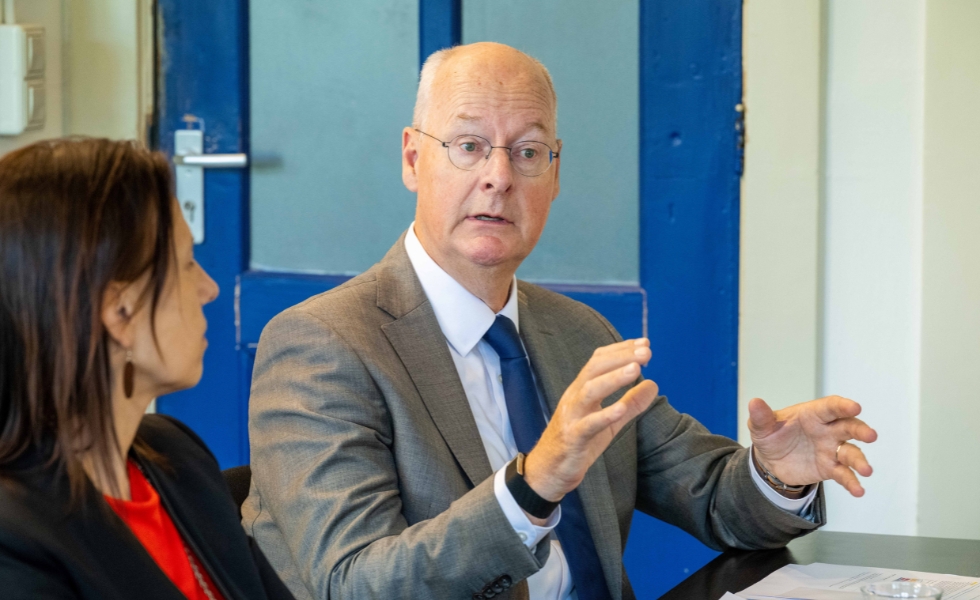
How can you make social impact transparent to participants and end investors? During a round-table discussion organised by Financial Investigator, no fewer than seven experts, led by Laure Wessemius-Chibrac of NAB Impact Investing, discussed the way in which impact investing is developing.
In part 3 of the round-table discussion ‘From Theory of Change to Measurable Impact and Financial Return’, the participants look ahead. They discuss the influence of geopolitical developments, the relationship between impact and return, and how impact investing can be better explained to participants and end investors.
By Daphne Frik
|
CHAIR Laure Wessemius-Chibrac, NAB impact investing
PARTICIPANTS Marjolein Meulensteen, a.s.r. vermogensbeheer Sasha Miller, Nuveen Cherry Muijsson, BlackRock Gert-Jan Sikking, PGGM Vincent Triesschijn, ABN AMRO Eszter Vitorino, Van Lanschot Kempen Investment Management Boris van Warmerdam, Wonderland Impact Investments |
Are geopolitical developments giving rise to new sustainability and impact themes alongside the SDGs?
Sikking: ‘We use the SDGs as a framework for positive contribution and impact investments, but those goals officially run until 2030. At the same time, the world is changing rapidly. Geopolitical developments are giving rise to new themes such as energy security, defence and strategic infrastructure. Consider, for example, the debate on European independence, energy supply or digital resilience. This also raises the question of which themes will form part of the next generation of sustainability and impact objectives. Perhaps the focus will then shift more towards societal resilience and strategic autonomy, as described, amongst other things, in the Draghi report.’
Miller: ‘What strikes me most is how far we still are from the SDGs. At international meetings, it is becoming increasingly clear just how large the funding gap still is to actually achieve those goals. Furthermore, you see that governments have fewer resources available and that philanthropy alone cannot fill that gap either. This only makes the question all the more urgent: how can we mobilise much more private capital towards impact investments?’
This is ordinary people’s money. If they don’t understand what is happening to their assets, you’ll face resistance.
Triesschijn: ‘It’s also about transparency. People understand issues such as energy security, child labour or affordable healthcare very well, as long as you make it concrete and can demonstrate what an investment actually changes. Furthermore, the return must be good. I believe that is also crucial for maintaining support for SDG targets in investments.’
Sikking: ‘Pension funds must invest in the interests of their members, and members are now also paying closer attention to social stability. It is no longer just about financial returns, but also about the kind of society people will be retiring into. Issues such as energy security, healthcare and geopolitical stability are playing an increasingly significant role in this.’
Muijsson: ‘The question is also how to translate new supply chain risks into asset allocation and portfolio construction. This is not just about sustainability, but also about transition risks, physical risks and strategic dependencies in food chains and healthcare. Investors must therefore gain an ever-better understanding of how these developments influence their long-term returns and portfolios.’
Vitorino: ‘You can see that systems thinking is becoming increasingly important. Impact is no longer just about individual projects, but also about broader societal resilience. We’re seeing that the focus is increasingly on how investments contribute to larger-scale transitions and to the functioning of systems, for example in the areas of energy, healthcare or infrastructure.’
Should the definition of fiduciary duty be broadened to explicitly include social and environmental impact, or was Thierry Aartsen right that pension funds should focus exclusively on financial returns?
Vitorino: ‘Impact investments must continue to perform financially, but in my view, fiduciary duty is also about the long term. You cannot view climate risks, biodiversity loss or social instability in isolation from financial returns: such developments also have an impact on economies, companies and portfolios. That is why I think it is too narrow a view to consider fiduciary duty solely in terms of short-term financial returns.’
Meulensteen: ‘If you ignore systemic risks such as climate change, you are actually failing in your fiduciary duty.’
Muijsson: ‘The problem is often one of framing. All too often, people still act as if impact investing automatically comes at the expense of returns. That is simply not true. Of course, you need to consider risks, tracking error and the role of impact strategies within a broader portfolio, but issues such as climate change, biodiversity and social stability also have financial consequences.’
Sikking: ‘In the Netherlands, pension legislation already stipulates that pension funds must take non-financial factors into account. So that has actually been part of fiduciary duty for a long time.’
Meulensteen: ‘And members also want to be able to retire into a liveable world.’
Sikking: ‘PFZW conducts a great deal of research amongst its members. And what does it show? Many people consider sustainability important, even if it might cost a little extra. Other members want the highest possible financial return. The pension fund must take this information from its members into account when drawing up its investment policy.’
We strongly believe in storytelling. A story about additional healthcare capacity, renewable energy or affordable housing is much easier to understand than complex impact tables.
Miller: ‘In the United Kingdom, fiduciary duty is also currently being reviewed. Approaches are changing in various markets.’
Is the idea that impact investing comes at the expense of financial returns a misconception?
Muijsson: ‘Yes, that is a misrepresentation of the facts. Of course, impact investing sometimes requires a longer time horizon, different benchmarks or a different risk budget, but that does not automatically mean lower returns. Many discussions are still conducted in too black-and-white a manner, as if investors have to choose between financial returns and social impact. Our research shows that markets are already factoring water scarcity and more efficient water use into company valuations. Investing in water solutions is, in fact, also an impact theme.’
Vitorino: ‘The impact investing market is rapidly becoming more professional, making it increasingly important for investors to be able to identify the winners within the sector. For fund managers, this means that a strong manager selection team is essential for identifying standout players and assessing them convincingly. Impact and returns go hand in hand and actually reinforce one another.’
Triesschijn: ‘We’ve had years in which impact mandates actually outperformed traditional investments, and years in which the opposite was true. Over longer periods, the performance is often much closer. This also shows how much these kinds of discussions depend on the chosen time frame. If you look only at short periods or at the best-performing share indices at that moment, you quickly end up with a skewed picture. Ideally, investors should have a longer-term horizon and look beyond the cycle.’
Sikking: ‘At the same time, you have to remain realistic. Some high-impact projects simply offer too low an expected return for the risk involved. In such cases, we still won’t invest in them. Pension funds, of course, remain responsible for the financial interests of their members.’
Miller: ‘For many impact strategies, we apply the same return targets as for conventional strategies. This is important to make it clear that impact investing is not philanthropy. It involves investments that create both financial and social impact.’
Muijsson: ‘Many discussions also arise because investors do not pay sufficient attention to risk-adjusted returns or to the role of impact within a broader portfolio. Some impact strategies, for example, can actually help to reduce certain transition risks or long-term risks.’
Triesschijn: ‘Benchmarking also plays a role in this. The question should actually be broader: what is the role of such an investment within the overall portfolio and in the longer term?’
Van Warmerdam: ‘As long as impact investing is viewed as something separate or idealistic, that debate about returns will keep resurfacing. That is why it is so important for impact investing to become more professionalised and to be integrated more fully into mainstream investment processes. Impact should not be seen as separate from returns, but should become part of how we assess risk, value creation and long-term returns.’
Are traditional benchmarks still suitable for assessing impact investments?
Triesschijn: ‘Benchmark thinking doesn’t help. Many impact strategies simply have a different risk profile, a different time horizon or invest in different sectors to mainstream benchmarks.’
The sector needs to explain much more clearly that impact investing is not the same as philanthropy.
Sikking: ‘It is a fundamental challenge for the entire sector. Traditional benchmarks are based on the world’s largest companies, not on sustainability or social value. As a result, they do not always align well with the objectives of impact investing.’
Muijsson: ‘Many investors are therefore looking for supplementary benchmarks that already incorporate climate risks, transition risks or sustainability choices. This also helps to better explain investment decisions to boards and participants.’
Miller: ‘We see that institutional investors are still grappling with the question of where exactly impact fits within asset allocation. Is it a separate category? Or should impact be integrated across the board? Our surveys of institutional investors worldwide show that approaches are changing.’
Vitorino: ‘As long as performance is assessed solely in financial terms, the discussion remains oversimplified. Ultimately, you need to look at financial and social outcomes together. Otherwise, you miss out on a significant part of the value that such investments aim to create.’
Triesschijn: ‘For retail investors, an absolute long-term comparison sometimes works better than complex relative benchmarks. Many people simply want to understand what an investment yields in euros and what it achieves in social terms.’
Sikking: ‘If you can explain that an investment not only delivers a financial return but also, for example, creates extra capacity in healthcare or contributes to the energy transition, that appeals to people far more than purely financial investment information.’
How can investors better explain impact investing to participants and end investors?
Triesschijn: ‘This is ordinary people’s money. If they don’t understand what’s happening to their assets, you’ll meet with resistance.’
Sikking: ‘That’s why we strongly believe in storytelling. A story about additional healthcare capacity, renewable energy or affordable housing is much easier to understand than complicated impact tables. Of course, you need data, but you also need to be able to tell a clear story that resonates with participants.’
Vitorino: ‘It needs to be made tangible. People want to know what their money is actually changing. That means you shouldn’t just show abstract figures, but also real-life examples.’
Muijsson: ‘Participant surveys also help with this. In recent years, many pension funds have done a much better job of identifying participants’ actual sustainability preferences. This also makes it clearer which themes are considered socially relevant.’
Miller: ‘The sector needs to explain much more clearly that impact investing is not the same as philanthropy. It is, in fact, about investing with both financial and social returns. Many people still think that “impact” automatically means you have to sacrifice financial returns.’
Van Warmerdam: ‘Greater transparency also helps to add nuance to the public debate. This is particularly important now that there is growing political resistance to ESG and impact investing. The better you can explain what these investments actually achieve, the stronger the public support will remain.’
Meulensteen: ‘Ultimately, participants don’t just want a good pension; they also want a liveable society in which they can enjoy that pension. It is up to us as investors to be transparent about the choices we make.’
|
Laure Wessemius-Chibrac Laure Wessemius-Chibrac has been committed to developing the impact investing ecosystem for many years and is Managing Director of the NAB, the trade association for impact investors in the Netherlands. Previously, she was Head of Investments at Cordaid, an international NGO and impact investor, and worked as an investment banker at BNP Paribas and ABN AMRO Rothschild. |

|
Marjolein Meulensteen Marjolein Meulensteen works as a Senior Adviser on Responsible Investment at a.s.r. Asset Management. In her role, she is responsible for developing strategy and policy on responsible investment, as well as policy on biodiversity and natural resources. She previously worked at a.s.r. as Sustainability Manager and as a Consultant in International Environmental Policy. Meulensteen holds an MSc in Ecology & Natural Resources Management from Utrecht University. |

|
Sasha Miller Sasha Miller is Head of RI Strategy within the Responsible Investing team at Nuveen. She leads a team focused on shaping the strategy for the responsible investing platform. This includes developing RI capabilities and conducting research across various regions, as well as innovating and developing client solutions and partnerships. She is also chair of the RI SteerCo and oversees the Nuveen impact platform. |

|
Cherry Muijsson Cherry Muijsson is Chief Investment Officer in BlackRock’s fiduciary team for pension funds in England, the Netherlands and the Nordics. She is responsible for portfolio construction, asset allocation and research, and leads BlackRock’s investment case for nature and biodiversity. She obtained her PhD in financial macroeconomics from the University of Cambridge. Her work has been published in international journals. |

|
Gert-Jan Sikking Gert-Jan Sikking is a Senior Sustainability Adviser within the Total Portfolio Management department at pension asset manager PGGM. Since 2015, he has been focusing on Sustainable Development Investments and on measuring and reporting the environmental and social impact of SDI and impact investments. Sikking is currently involved in various initiatives in the Netherlands in the field of social entrepreneurship. |
|
Vincent Triesschijn Vincent Triesschijn is Head of Sustainable Investment at ABN AMRO and focuses on integrating sustainability into investment decisions, engagement and regulatory matters. He previously worked at UBS, J.P. Morgan and Van Lanschot Kempen. He holds a Master’s degree in Sustainability from the University of Cambridge and advises sustainable start-ups. Under his leadership, sustainable investment at ABN AMRO grew significantly and the bank won several European awards. |
|
Eszter Vitorino Eszter Vitorino is Impact Lead at Van Lanschot Kempen Investment Management. She works at the intersection of capital, sustainability and systemic change, and translates complex impact issues into clear insights on how investments can contribute to measurable social and environmental outcomes. |

|
Boris van Warmerdam Boris van Warmerdam is a Partner at Wonderland Impact Investments, an investment management platform that creates large-scale social and financial value through impact propositions in the fields of land, water, property and infrastructure. Van Warmerdam has over 20 years’ experience in fund and portfolio management, business development, finance and risk. Previously, his roles included co-founding LIFE Europe and serving as Managing Director at Grosvenor. |
Read the report in the digital magazine