
Harry Geels: Put an end to the left-right framework – part 2

This column was originally written in Dutch. This is an English translation.
By Harry Geels
Last week, I argued that the current left-right framework falls seriously short. This week, I’m focusing on the left-hand side of my political axis. There, too, the differences appear to be much greater than is often assumed.
Anyone walking into a random student room has a reasonable chance of coming across the famous portrait of Che Guevara. To some, he is a freedom fighter who stood up for the oppressed. To others, he is a violent revolutionary who bore joint responsibility for executions following the Cuban Revolution. Interestingly, both groups often agree on one thing: Che was ‘left-wing’. In last week’s column, I used three arguments and the many different parties on the ‘right’ to explain why the left-right framework is flawed.
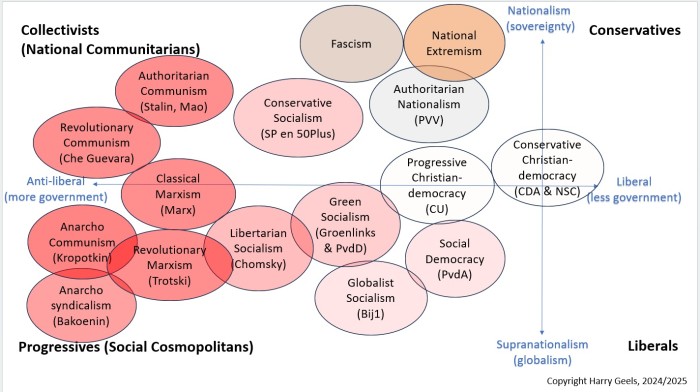
This framework is unnecessarily simplistic and, as a result, stigmatising and polarising. There are so many shades of grey that labelling someone as left-wing or right-wing is all too easily intellectually impoverished and stands in the way of in-depth analysis. Finally, political movements do sometimes change their views – radically, even. Who, for example, would ever have thought that socialists would now embrace armament and the military! Along the continuum of high versus low state intervention, we see a wide diversity of movements. The figure below shows the movements in the left-hand quadrants.
Che was not Marx
For many people, ‘left-wing’ politics begins and ends with Karl Marx. Yet Marx would probably not readily recognise himself in many of the movements in the two left-hand quadrants of my coordinate system. Marx primarily developed a theory of history, class struggle and economic development. According to him, capitalism would ultimately lead to large concentrations of capital. His vision came true, but – as argued here – not, or only partially, for the reasons he gave.
Che Guevara was concerned with something quite different. His central question was not how capitalism would develop, but how a revolution could be actively brought about. Unlike Marx, he did not believe that one should wait passively until the economic conditions were ripe. In his view, a small revolutionary vanguard had to ignite the spark that would set a revolution in motion. Che therefore represents not so much classical Marxism, but rather what is referred to in my framework as revolutionary communism.
Trotsky versus Stalin
There are more shades of grey. Take Leon Trotsky, one of the leaders of the Russian Revolution. He, too, was a revolutionary, but in a different way to Che. Trotsky believed in a permanent international revolution. In his view, socialism could ultimately only succeed if it spread across several countries. This placed him in direct opposition to Stalin. Remarkably, Trotsky and Stalin are nowadays often both simply referred to as ‘communists’, even though their views differed fundamentally. Stalin, on the other hand, defended the idea of ‘socialism in one country’ and built a highly centralised, authoritarian state.
Kropotkin and Bakunin
The Russian thinkers Kropotkin and Bakunin both rejected the nation state. Bakunin emphasised the revolutionary overthrow of power, whilst Kropotkin became best known for his vision of voluntary cooperation and mutual aid as the basis for a stateless society. Furthermore, Bakunin envisaged a role for remuneration based on labour within a system of collective ownership. Kropotkin moved further towards anarcho-communism: in his view, production and distribution should be based on needs, without wages or money as an organising principle.
Chomsky
Finally, Noam Chomsky presents a special case, as he described himself as a socialist libertarian. He shared a common ground with well-known classical libertarians such as Milton Friedman and Friedrich Hayek (see previous column) in that he sought to limit the economic power of large corporations and a large state. Classical libertarians, however, saw free markets and private property as the solution to concentrations of power, whilst Chomsky sought economic democracy through workers’ self-management and voluntary cooperation. Chomsky demonstrates that apparent opposites can pursue the same political goal but interpret it in a (slightly) different way.
Fascism
Fascism is likely to provoke the most discussion in my framework or coordinate system, as in public debate it is often mentioned in the same breath as the ‘right’ or even the ‘far right’. In my coordinate system, it is situated in the top-left corner. The reason is that I do not primarily classify political movements on the basis of the polarising left–right divide, but on the basis of their view of state power and national sovereignty. Fascist regimes were characterised by a strong and authoritarian state, the subordination of individual interests, far-reaching control of society, and a close intertwining of government and business through corporatist structures. At the same time, fascism was violently anti-socialist, defended private property and hierarchy, and actively sought out the industrial elite.
At the same time, the fascists were strongly nationalistic. In my model, this combination of far-reaching collective control and nationalism therefore places fascism in the top-left quadrant. This does not mean that fascism is the same as communism or socialism, but it does mean that these movements share an important characteristic: the conviction that the collective ultimately takes precedence over the individual. Historically, however, they differed fundamentally on issues such as class, property, nationalism and internationalism.
I am not alone in this view. Thinkers such as Ludwig von Mises and Friedrich Hayek pointed out that, despite their mutual hostility, fascism and socialism share important characteristics, such as the subordination of the individual to collective goals and a major role for the state.
Probably even more movements
The political movements mentioned here are probably not yet exhaustive. For example, there is also the council communism of the Dutch thinkers Anton Pannekoek and Herman Gorter. Their anti-authoritarian, anti-parliamentary Marxism (workers’ councils instead of a party or a state) forms precisely the bridge between the authoritarian communists at the top left and the anarchists at the bottom left. It also reinforces my view that ‘communist’ is an umbrella term for opposing ideologies. And what of Pierre-Joseph Proudhon’s mutualism, which lies very close to Chomsky’s socialist libertarianism?
Final thought
What do Stalin, Che Guevara, Trotsky, Chomsky and Kropotkin on the one hand, and authoritarian nationalism, fascism and green socialism or globalist socialism on the other, have in common? Far less than public debate suggests. They differ in their views on the role of the state, on property, on international cooperation, on revolution versus reform, and even on the question of whether a nation-state should exist at all. If we label these movements as the (extreme) left, we lose sight of precisely those differences that make politics interesting.
Political movements do not form a straight line with the left on one side and the right on the other. The political landscape bears far more resemblance to a world map with diverse traditions, which are sometimes closer together than one might think and sometimes miles apart. Che Guevara, Stalin and Kropotkin, for example, could all be called communists. Yet Stalin believed in a strong, centralised state; Che strove for revolutionary vanguard politics; and Kropotkin, on the other hand, wanted to abolish the state entirely.
The left-right framework replaces those differences with a single label. And the more we focus on those labels, the less we understand the ideas behind them.
This article reflects the personal opinion of Harry Geels