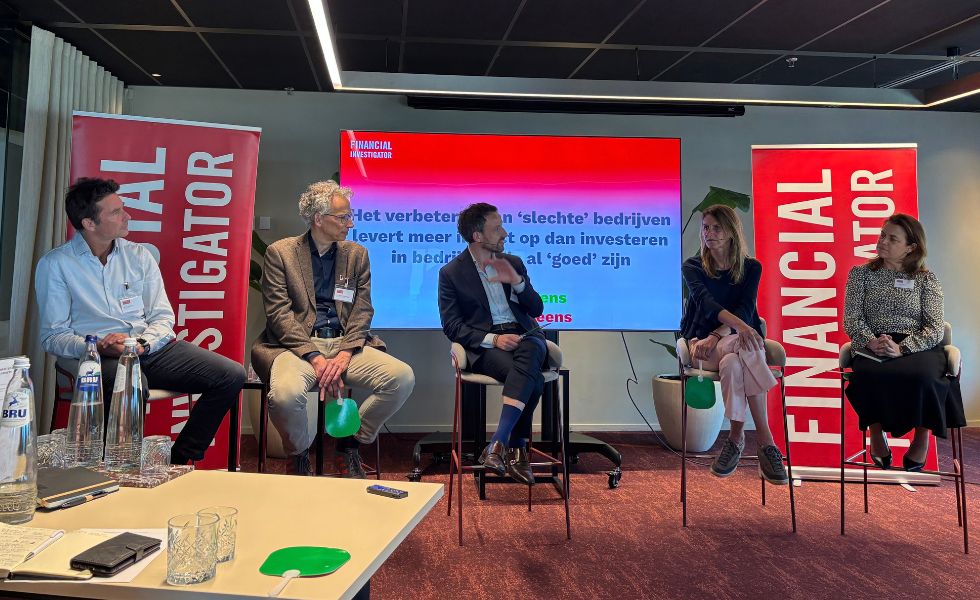
Panel discussion 'Impact Investing in Private Markets'
This report was originally written in Dutch. This is an English translation
Impact and returns are increasingly shown to go hand in hand, leading family offices to embrace impact investing more and more. The challenge is therefore shifting to a different question: where can capital actually make a difference?
By Baart Koster
At the seminar organised by Financial Investigator, entitled ‘Impact Investing in Private Markets for Family Offices’, the opening assertion that impact comes at the cost of returns initially seemed to receive little support. Most of the red placards are raised in the room. The majority of those present disagree. Yet it soon becomes clear that the discussion is less black-and-white than the vote would suggest. After all, what do investors mean by ‘impact’? And what returns are they talking about? These questions form the starting point for a panel discussion on how impact objectives can be translated into concrete investment mandates. Moderated by Koen Ronda of IBS Capital Allies, the discussion covers a wide range of topics: from returns and impact measurement to private markets, emerging markets and the role that investors themselves wish to play.
The common thread running through the discussion is that it is not so much about the desire to make an impact, but about how that ambition takes shape in practice. This is evident right from the opening statement. Most attendees do not believe that impact investing necessarily comes at the expense of returns, but the panellists are quick to introduce the necessary nuances.
‘It depends very much on the themes you invest in, the asset classes, the time horizon and the managers you select,’ says Ita Demyttenaere of BlackRock. In certain segments, impact and returns appear to go hand in hand, particularly when they are deliberately integrated within a broader portfolio. Demyttenaere refers to research showing that many impact managers aim for market-line returns and report that they are able to achieve them. At the same time, there are themes where this is less straightforward. ‘In climate infrastructure and certain forms of green finance, we have seen that market-line returns have been possible in recent years. In the case of circularity, for example, this proved more complicated during the same period,’ says Demyttenaere.
Seeking additionality
Guido Boysen of Blink Impact also sees significant differences between the various impact themes. His organisation, a family office, invests in areas including developing countries, biodiversity and ocean finance – themes which, in his view, remain relatively underfunded. ‘We are increasingly gravitating towards that category, because if a great deal of capital is already flowing into themes where impact and returns go hand in hand, the question naturally arises as to what our role as a family office is,’ says Boysen. In his view, it is precisely in these kinds of markets that impact investing requires a realistic assessment of risks, liquidity and returns. At the same time, Boysen sees opportunities there to make a difference and allocate capital to themes where the need for funding still exceeds the available supply.
Jan Bertus Molenkamp of Impact Orange Partners points out that the chosen impact theme also makes a significant difference. ‘With climate transition-style approaches, it is often possible to achieve good returns. But if you look more closely at social objectives, such as those included in the SDGs, it often becomes more difficult.’
An important nuance comes from Diana Wesselius of Anthos Fund & Asset Management. According to her, different forms of impact investing are still too often lumped together. ‘There are different impact mandates, and these are not always clearly distinguished in communications.’ In her view, there is a significant difference between concessional capital and commercial impact investments. In the former case, investors consciously accept a lower return to enable something that the market has not yet taken up. In the latter case, the aim is precisely to achieve market-rate returns within an impact strategy. ‘These are often placed under the same label. As a result, the perception persists that impact investing always comes at the expense of returns.’
From ambition to measurable goals
Once the debate on returns has been explored, the focus shifts to another question: how do you make impact objectives concrete? According to Molenkamp, this does not start with a fund or an asset class, but with the investor themselves. ‘What inspires you? What do you want to improve? That’s always where it starts.’ Only then does the translation into an investment strategy follow. In his view, a clearly formulated ‘theory of change’ plays a key role in this. This clarifies how an investment is ultimately intended to contribute to a social goal. ‘You’re essentially explaining what you’re going to do and why that will actually make a difference. This creates a logical link between what you do and what you ultimately want to achieve.’ According to Molenkamp, this allows you to link objectives to measurable indicators in a transparent way.
According to Molenkamp, there is no need for anyone to develop new methodologies for this themselves. ‘A great deal is already available, such as international databases, KPIs and units of measurement that you can simply use.’ Nevertheless, he warns against an overly rigid approach. Particularly within private markets, reality often proves more unruly than a pre-defined model. ‘You need to combine top-down and bottom-up approaches. Otherwise, you’ll end up ruling out a great many interesting investments simply because they don’t quite fit the framework you devised in advance.’ According to Molenkamp, this requires a certain degree of flexibility, as not every investment that can contribute to an investor’s impact objectives will fit seamlessly within a pre-defined framework.
A rapidly growing universe
The question of how impact objectives can be achieved ties in directly with the next topic: are there actually enough investable propositions available? According to Marlene Stam of Collective Action, the answer is a resounding yes. ‘When I first came into contact with impact investing fifteen years ago, it was mainly about financial inclusion and healthcare. If you look now, that market has grown enormously. ’ In recent years, numerous specialised impact funds have emerged around themes such as climate, food security, oceans, education and healthcare. In addition, interest in private debt as an impact instrument is growing. However, according to Stam, this does not mean that every market is equally accessible or mature. ‘The oceans are a fantastic theme, but there are perhaps only five or six specialists worldwide who are of real interest to Dutch investors.’ That is why, she argues, impact investing increasingly demands knowledge, selection and market insight. The number of opportunities is growing rapidly, but not every theme has the same scale, the same track record or the same number of specialised providers.
You need to combine a top-down and bottom-up approach. Otherwise, you’ll rule out a great many interesting investments simply because they don’t quite fit the framework you’ve devised in advance.
According to Stam, the appeal of certain impact themes partly depends on the type of investor. ‘Many families are drawn to later-stage venture capital because of the innovation, entrepreneurship and the opportunity to support new solutions at a relatively early stage. Institutional investors tend to focus more on growth capital, infrastructure and real assets strategies that can roll out proven solutions on a larger scale.’
Boysen recognises this picture. His organisation sees a large number of investment proposals come through every day, but has actually become more selective. ‘We’re becoming increasingly focused. Precisely because there are so many opportunities.’ According to him, this also applies to the younger generation within family offices, who are often enthusiastic about new impact themes. ‘You do have to be honest about the risks. In Africa, venture capital is still a relatively recent phenomenon. There have been few exits. If you consider that market important, you need to view it realistically.’
Define your role
Gradually, the focus is shifting from the investment itself to the investor’s position. According to Stam, that is perhaps the most important question of all. ‘Before you even start investing, you need to think carefully about the role you want to fulfil.’ Some families choose to take a leading role within a particular theme. Others collaborate with academic institutions, civil society organisations or other families. Still others focus primarily on scaling up existing solutions. According to Stam, this is not just about what is being invested in, but also about how influence is exercised. ‘Do you want to make an immediate impact? Do you want to see immediate results? Or do you want to be part of systemic change?’
Investors are increasingly seeking to collaborate in this regard. This allows knowledge, networks and capital to be combined. According to Stam, this is precisely where a significant opportunity arises for impact investors. ‘You can act as a catalyst. Sometimes you make a bigger difference by helping a smaller fund grow at an early stage than by participating in a fund that everyone is already in.’
Molenkamp agrees. ‘There’s no shame in wanting to do good without spending a lot of time on it. In that case, you engage in impact investing. But if you want to do more, you take on an active role in impact investing.’ Molenkamp believes that such active involvement can be a significant added value for entrepreneurial families. After all, in addition to capital, they possess experience, connections and entrepreneurial spirit that can help an initiative move forward.
The impact of change
One of the most interesting arguments centres on the question of where impact is ultimately greatest: in companies that already operate sustainably, or, conversely, in businesses that are still in the midst of their transition. Demyttenaere explicitly opts for a nuanced view. ‘I certainly think you can make a significant impact with high-emission companies that are in the midst of the energy transition. And in some cases, even more so than with green companies.’ He cites the example of an energy producer that transformed from a fossil-fuel energy producer into a company fully committed to renewable energy. At the same time, Demyttenaere warns against stretching the concept of impact investing too far. ‘I actually think it’s good to have a pure strategy where you know very clearly that it’s focused on positive impact.’
If you want to do good without spending too much time on it, you opt for impact investing. But if you want to do more, you engage in impact investing and take on an active role.
According to Demyttenaere, investment is also necessary in polluting sectors that are working towards becoming more sustainable. Without such transition financing, many social goals will not be achieved. ‘If investors want to tackle challenges such as the energy transition, they cannot rely solely on impact investing. You also need to look at companies that currently emit more, but are part of the energy mix.’ This creates a broader view of the role of capital. It is not only new solutions that deserve funding; existing sectors must also be helped to change.
New markets, major impact
The final point of debate focuses on the question of where impact capital can make the biggest difference. According to Wesselius, developed and emerging markets are not so much competitors as different playing fields. ‘In developed markets, existing markets are being adapted, made more sustainable or more accessible. In emerging markets, impact investments sometimes create entirely new markets.’ In many emerging economies, financing needs are greater and there are fewer active investors, according to Wesselius. ‘If additionality is important to you, you often make a bigger difference in emerging markets than in developed markets.’
If additionality is important to you, you often make a bigger difference in emerging markets than in developed markets.
However, this does require an understanding of local circumstances, warns Wesselius. Sustainability objectives can clash with the economic reality of countries where access to energy is not yet a given. ‘If, in certain parts of Africa, you say that investment in gas-related activities should no longer be permitted, this often leads to a lack of understanding. It clashes with the reality on the ground, where there is actually a severe energy shortage.’
I certainly think you can make a significant impact with high-emission companies that are in the midst of the energy transition.
Boysen, too, sees major opportunities in emerging markets, particularly in countries such as India and Brazil. ‘The quality of innovation there is now extremely high.’ He sees opportunities that are both socially and economically interesting, particularly in technology, entrepreneurship and AgriTech.
Diverse objectives
At the end of the discussion, a question comes from the audience: what motivates family offices to opt for impact investing? According to Boysen, there is no single answer to this. ‘If you know one family office, you know just one family office.’ For him, social engagement plays a crucial role. ‘Our principals have a clear vision. They want to allocate part of their capital to social causes. We don’t mind if that yields a return, as long as it generates an impact.’ For other families, returns, liquidity or capital preservation may carry greater weight.
Molenkamp and Demyttenaere observe a similar tension amongst institutional investors. Whilst pension scheme members often express a desire to make an impact, they are not always prepared to sacrifice returns to achieve this. Moreover, they frequently have conflicting preferences. It is therefore not always straightforward for a pension fund to define its mandate in this regard.
Sometimes you make a bigger difference by helping a smaller fund grow at an early stage than by investing in a fund that everyone else is already in.
Impact investing therefore turns out not to be a clearly defined concept, but a collective term for a wide range of strategies and ambitions. Investors are defining ever more precisely what they wish to achieve, what role they wish to play in this, and under what conditions they are willing to commit capital. Above all, the discussion shows that the intention to make an impact is now widespread, and that the main focus is now on where capital can add the most value.
|
SUMMARY Impact and returns are not necessarily mutually exclusive. Feasibility depends heavily on the theme, asset class, time horizon and chosen manager. Additionality is becoming increasingly central: investors are looking for areas where capital actually makes a difference. Impact objectives require a clear theory of change, measurable targets and scope for customisation. The range of impact investments is growing rapidly, but requires specialist knowledge and careful selection. Emerging markets often offer more impact opportunities due to a greater need for capital. |