Roundtable 'Impact Investing in Private Equity'
This report was originally written in Dutch. This is an English translation
Impact and return need not be mutually exclusive. Indeed, when social solutions develop into scalable business models, the two can reinforce each other. But how do you identify the right opportunities? How do you demonstrate impact? And what role can institutional capital play in bringing about genuine systemic change?
By Hans Amesz
|
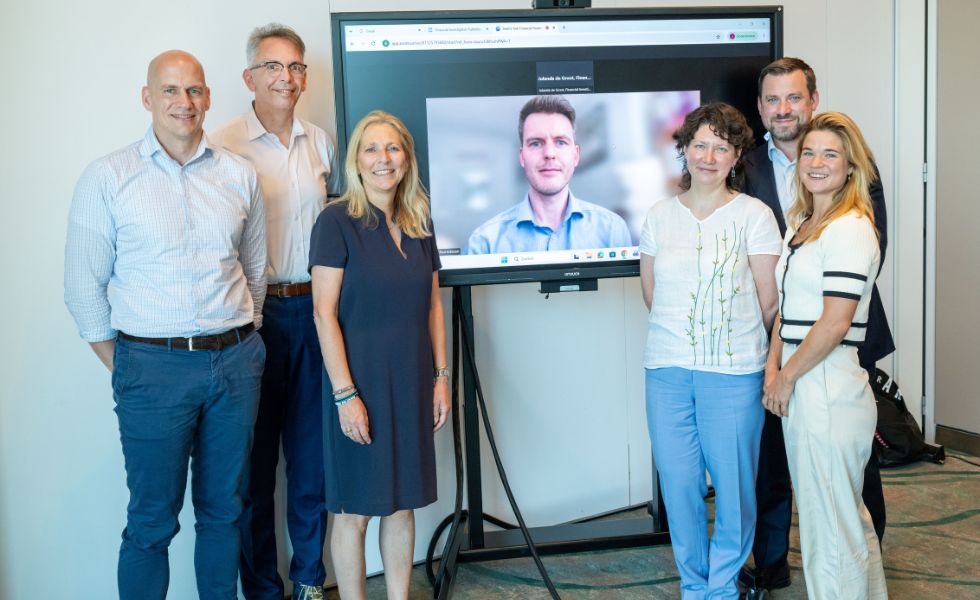
VOORZITTER: John Renkema, Avida International
DEELNEMERS: Paul Acheson, Federated Hermes Simone Brummelhuis, Borski Fund Jonathan Dean, BNP Paribas AM Alts Xenia Loos, Collective Action Investment Partners Hanna Lukács, ING Investment Office Simon Oosterhof, Van Lanschot Kempen Investment Management Jennifer Signori, Neuberger |
What is your definition of impact investing?
Jonathan Dean: ‘For us, it’s about investments that deliver a measurable, deliberate social and environmental outcome whilst also generating a financial return at market rates.’
Paul Acheson: ‘Impact investing is investing with a view to achieving a measurable, positive social or environmental impact, but in combination with a financial return that must not come at the expense of the impact.’
Hanna Lukács: ‘For me, impact investing starts with intentionality, but it only becomes a true impact when there is additionality and when measurable changes take place in the real world. The difference lies not in owning a good company, but in financing change that would not otherwise have taken place. Not every sustainable investment is an impact investment. Ultimately, the question is: what actually changes as a result of this capital becoming available?’
How do institutional investors integrate impact objectives into private equity strategies without compromising return expectations or fiduciary duties?
Dean: ‘It has now been amply demonstrated that it is possible to achieve both a financial return at market value and meaningful impact outcomes. We now have an asset class that institutional investors can support as part of their fiduciary duty.’
Simon Oosterhof: ‘When pursuing a market-in line return, it is largely about integrating impact as a source of value creation. Scaling up solutions to societal challenges can simultaneously generate both positive impact and financial returns. That way, you don’t have to make any concessions on returns.’
Simone Brummelhuis: ‘There are new themes through which you can have a significant impact and build a strong financial business case. For example, women’s health, a theme that has so far been completely overlooked. It is important to clearly define in advance what you mean by a market-rate return, so that impact and return objectives are clear and can be properly balanced.’
Lukács: ‘Impact investing requires greater transparency regarding how returns are generated and the associated long-term effects. This reinforces the responsibility we have towards our clients and final beneficiaries. Ten years ago, we wondered whether fiduciary duty left room for impact investing. Today, we must ask ourselves whether fiduciary duty takes sufficient account of systemic risks such as climate change, biodiversity loss and social inequality.’
Dean: ‘It is the asset manager – the investor – who determines what return expectations they assign to the market return. The beauty of impact investing is that you can actually invest in impact, whereby that impact creates value and drives returns. Women’s health is a wonderful example of this. There are numerous examples of how investments in something distinctive can boost both the impact and the return.’
Xenia Loos: ‘We have a role to play in demonstrating that it is possible to perform well and do good at the same time. As a society, I think we need to reflect on the definition of fiduciary duty. At this stage, that means not only ensuring, for example, that pensioners are well looked after, but also that there is a future in which people can retire.’
Impact investing requires greater transparency regarding how returns are generated and the associated long-term effects
Acheson: ‘For us, it is crucial that impact objectives are aligned in some way with the company’s economic success, so that there is a strong connection between achieving both outcomes and so that one does not come at the expense of the other. When companies are set up to respond in a wholly commercial manner to the demand for solutions to specific problems, this fits perfectly with our programmes.’
What are the key considerations when setting up an impact investment programme for private equity?
Oosterhof: ‘The starting point is always: what does the client want to achieve? We then formulate an impact thesis: a well-founded vision of which asset classes, strategies and sectors are expected to contribute to the desired impact outcomes whilst offering attractive financial opportunities. In doing so, we look, amongst other things, at the quality and scalability of companies’ revenue models. This impact thesis forms the basis for our investment selection and portfolio construction.’
Loos: ‘It’s about thinking very carefully about the investment opportunities available today, enabling institutional investors to achieve their desired objectives for both impact and return. We have seen that there is sometimes a discrepancy between what institutions want and what is actually available. I believe you need to be on the ground and form part of the impact investment ecosystem and the private markets in order to fully realise these two objectives.’
When pursuing a market-rate return, it is largely a matter of integrating impact as a source of value creation.
Dean: ‘If you can link an impact programme to one of your core business activities, your stakeholders will fully support it and you can start communicating results that are relevant to your business. That is why insurance companies are among the largest investors in impact strategies. The same could also apply to pension funds and their members. We have selected the ideas that, in our view, delivered the most compelling impact results whilst also offering the most attractive financial returns. The solutions we propose are intended for those who wish to invest in a healthcare strategy or a natural capital and climate strategy, rather than everything in a single product.’
Brummelhuis: ‘It must be borne in mind that some impact areas are still in their infancy and that, for example, innovations in this field within the private sector are still relatively new. It is precisely in emerging impact areas that the greatest opportunities to shape our future often arise. This requires a clear allocation strategy, patience and a willingness to give innovations time to grow.’
Lukács: ‘In my view, that is precisely where the crux of the challenge lies: the social problems for which we need impact investments are often at the forefront of innovation or require a niche focus, whilst institutional capital is naturally inclined towards scale, predictability and proven business models. To achieve impact on a large scale, we need to bring those two worlds closer together.’
Oosterhof: ‘Within our asset classes, we have impact specialists who jointly manage an impact mandate. Our team comprises specialists in private debt, infrastructure, property and private equity, and within these specific areas of expertise, we explore how best to implement an impact theme across the entire portfolio.’
Jennifer Signori: ‘This has been mentioned before, but it is important to emphasise that all considerations relating to investment objectives must be balanced against impact objectives – such as scale, risk-return and diversification – and against the available opportunities, in order to effectively manage expectations regarding the composition of the portfolio and the pace of investments. The use of a wide range of investment instruments, such as co-investments, secondary investments and investments in funds, can make a valuable contribution to the composition of a programme. For example, co-investments are useful for capital efficiency and targeted investment positions; however, if a programme’s impact themes are specific and not fully diversified, the pace of capital deployment may need to be adjusted.’
How should LPs today approach the allocation between venture growth and buy-out within impact private equity, given the trade-off between impact depth and return visibility?
Oosterhof: ‘On the one hand, it is about the relationship between impact and returns; on the other, it is about the timeframe over which impact manifests itself. In venture capital, for example, the impact outcome is often further in the future, whilst in growth investments the impact horizon is closer and returns are slightly more moderate than in venture capital. With buy-outs, income is more stable and returns more predictable, but the impact outcome – or the depth of impact – is often more limited. We believe that, particularly as an institutional investor, you should combine these different approaches to strike a good balance between impact, return and risk.’
Loos: ‘When thinking at portfolio level, it is important to also consider the innovation that needs to take place and to allocate resources to it, depending on the impact outcomes you are trying to achieve. There are an increasing number of buy-out opportunities in the impact sector. When assessing a buy-out fund, we must pay particular attention to the impact aspect.’
Dean: ‘We focus more on creating impact across the private equity spectrum, from venture to growth, because the simple definition of impact is: doing something new, creating something different, changing something. That is what impact means. If you look it up in the dictionary, it means you actually have to start with something that didn’t exist before; you have to create it. You do need to invest in new technologies, innovation, or scale something very small up to something big; that is really what impact is.’
Brummelhuis: ‘Many companies focus primarily on their own operations, whilst it is often within their broader value chain that the greatest impact can be achieved. If investors were to steer their investments more explicitly in that direction (for example, in side letters or through their allocations), this could further accelerate the development of impact investments.’
Acheson: ‘One of the considerations is the scale of the underlying investment opportunity and the possibility of deploying a significant amount of capital within an institutional risk-return profile. We regard the ‘venture’ and ‘growth’ asset classes as a larger market in which to invest our capital, but in fact the overlap between growth and buy-out is one of the most attractive stages in which to invest. The higher the growth, the more the impact objectives are achieved. But these are also the indicators of a successful, well-managed company.’
Signori: ‘Given the higher inherent risk associated with growth companies and start-ups, investors’ capital – assuming all other conditions remain the same and there are attractive opportunities to be found in buy-outs – could well flow en masse towards these more established companies. The potential impact there may well be scaled up, and this becomes more likely when capital is deployed to help companies scale up. This presents a trade-off compared with venture capital, where the impact may indeed be more catalytic or innovative, but the likelihood of lasting impact is lower given potential technological risks.’
How can manager selection and portfolio construction function in their own right as impact levers, and how can LPs use their position to promote systemic change and help the best GPs scale up their real-world impact?
Loos: ‘For us, systemic thinking means working across all your asset classes towards a specific outcome, such as changing the system or creating something new. This ranges from launching – or helping to launch – new technologies to ensuring sufficient infrastructure is in place to support the transition to renewable energy. It is very important to think about what you are actually trying to solve and to really understand the issue thoroughly. When I think about the food situation in the Netherlands and how I can contribute to that transition, I need to understand what is happening in the food system in a specific area and then try to align that with the opportunities I have. I believe that growth opportunities are currently the ones with the greatest impact and can deliver the best results within the foreseeable future.’
Brummelhuis: ‘We invest from a gender perspective. If many LPs were to increase their investment share in female GPs, that would bring about a massive systemic change. You would then invest in different companies, which would have a broader impact on society. You could close the financing gap, the innovation gap and the prosperity gap. The selection of managers is crucial, provided you do so consistently and not in isolation, but in close coordination with other LPs. Where the money flows is where the impact lies.’
For us, it is crucial that impact objectives are aligned in some way with the company’s economic success.
Loos: ‘There is great potential for impact in the private equity sector, but also in private markets in general. From an institutional perspective, however, not everything in this area is investable. Large institutions often have a vague understanding of impact, which means they do not wish to focus on it specifically. Many institutional investors are also less inclined to take on a little more risk in order to move towards what is actually termed ‘real impact’. In that sense, there is a gap. There are also many small impact funds that are performing well, but these are of no interest to larger institutional investors.’
Brummelhuis: ‘In new or relatively new areas, you have to take on more risk, and so you need pioneers who are prepared to invest in this. We see this not only in emerging markets, but also in the Netherlands. We know exactly which pension funds are taking the first steps in this fledgling sector.’
Acheson: ‘I think one of our roles as an LP is to identify, support and encourage truly credible impact managers within the sector who can deliver the best products and services in the future. Something we’ve done with many new managers in this sector is to share best practices and genuinely help them develop their strategies, their reporting, their KPIs and everything that goes with it.’
Dean: ‘We need to be innovative to offer solutions in which investors can invest. It is up to us to present an attractive investment product. The greatest leverage an LP can then utilise is to invest in the product by demonstrating commitment to that theme, committing capital and placing trust in the manager, and entering into a long-term relationship of ten to twelve years with the relevant funds. Once you’re on board, you realise the added value that an LP and a GP can work on together, and there are numerous levers involved. Providing support to portfolio companies, raising the firm’s profile, helping to raise capital: this is how you begin to venture into the realm of systemic change. This happens when your LPs are fully committed to supporting the GP and carrying out the mission, and that goes beyond simply providing capital.’
If you can link an impact programme to one of the core activities of your business operations, your stakeholders will fully support it.
Loos: ‘Structuring the right impact product is crucial, but it is also up to an investor or asset manager to engage in an open dialogue about exactly what is needed and what needs to happen before they can commit. I would describe that as a joint creation, which, in my view, does not happen often enough, but is something we as a sector must continue to work on.’
Oosterhof: ‘As an LP, you have a responsibility to discuss your vision with the GP and provide direction: which forms of impact and which investments do you believe are in line with the impact vision, which are less so, and to what extent do these investments contribute not only to direct impact but also to the broader systemic changes you wish to achieve?’
How do investors integrate impact considerations into their commercial due diligence in practice, rather than assessing them from a separate perspective, and how does this influence investment decision-making?
Dean: ‘It starts with the composition of your team and your process. For us, it’s fully integrated. If you’re investing for impact – which generates value and returns – it’s absolutely crucial that you identify the impact creation within your due diligence and secure it through your investment. To give an example: in the healthcare sector, it is no coincidence that our portfolio company supplies products that are sold in countries with both high incomes and high sales volumes. This is a very carefully considered process that is designed and assessed during due diligence, and implemented in collaboration with the company throughout the entire investment period. This requires a huge amount of work, resources, engagement with the company and contractual agreements to ensure that we invest in products that are inexpensive to produce, user-friendly and therefore suitable for global use, so that we can scale them up from high-income markets to high-volume markets. Ultimately, it’s all about the entire ‘theory of change’ behind your impact strategy. And if impact drives performance, it must be integrated.’
It is very important to think about what you are actually trying to solve and to understand the subject thoroughly.
Signori: ‘Impact and commercial factors must go hand in hand. In practice, this means that when assessing a potential opportunity, we examine whether a company’s core products and services are intrinsically linked to expected positive effects, rather than merely providing an additional benefit. We aim to identify impact KPIs that are relevant to the company’s business operations and that are incorporated into the financial model, so that impact assumptions can be taken into account alongside operational and financial assumptions and form part of the same approval process.’
Which sectors and themes currently offer the most attractive combination of measurable impact and scalable private equity opportunities?
Loos: ‘Climate solutions, climate technologies or climate applications are the most mature, certainly in terms of the range of opportunities on offer. Healthcare is also one of the more mature segments in the field of impact. In the areas of food and agriculture, and natural capital, we are enthusiastic about the growth and the interesting strategies that are emerging. Where we do not yet see enough solutions, but certainly want to find out more, are strategies that focus on the circular economy and the transition towards it.’
Brummelhuis: ‘Alongside climate, the women’s health sector will be a growing area in which we invest in the coming years.’
Oosterhof: ‘Climate is by far the biggest theme in our portfolio, because that is where we see the most opportunities. Health is also relatively important in our portfolios. Nature-positive and biodiversity-related investments, such as food, agriculture and the circular economy, currently make up a smaller proportion of the portfolio, but are certainly growing.’
Acheson: ‘We are very focused on the environmental aspect, more or less in response to direct demands from clients. From a sector perspective, we generally see that GPs have the most opportunities in industry and the services sector, particularly in areas such as testing, inspection services and technical services that support, amongst other things, the energy transition, electrification trends, water conservation and utility companies. We believe that these sectors offer the best way to gain exposure to themes that align with trends in the environment and the efficient use of resources, which are radically transforming the economy.’
Dean: ‘Our focus is on health, climate and natural capital. The greatest material impact can be achieved in these areas – namely climate change, biodiversity loss and health inequality. It starts with quantifying the scale of the problem, and that is what subsequently drives innovation in products and solutions, as well as investor demand to invest in areas that can have a substantial impact on the problem. Incidentally, there needs to be greater collaboration between the public and private sectors. There is a risk of a negative reaction to blended finance, but that may be because there was a lack of proper consultation beforehand. I don’t think this is the same as saying it doesn’t work, but that is what has happened in the market.’
Signori: ‘Climate and healthcare have already been highlighted and continue to account for a significant proportion of the opportunities. We have also identified interesting opportunities in the field of resource management and efficiency, as well as among service providers that support climate resilience and adaptation.’
Do you see nature-based solutions and natural capital as viable themes for private equity investment? And what structural shifts are needed to make them scalable and attractive to institutional capital?
Lukács: ‘Investments in nature remind me of renewable energy fifteen to twenty years ago. The societal need was evident, but the investment model still had to mature. Nature-based solutions bring together climate, biodiversity, food security, health and economic resilience. Examples of such solutions include companies specialising in regenerative agriculture, climate technology or satellite imagery. I believe this is the way forward. For me, it’s a foregone conclusion. It touches on many different aspects: carbon, biodiversity, procurement, soft commodities, people’s lives and their health. The question isn’t whether nature has value. The question is how we can develop investable business models centred on restoring, managing and strengthening natural capital. It can be very rewarding to bring all these elements together, and it’s all measurable. This is still in the start-up phase, but I hope it will come of age over the next five years.’
Dean: ‘We have launched an investment vehicle tailored to the areas where we see the greatest demand, and this stems from breaking down the opportunities surrounding climate change and biodiversity loss into the question: “Where can you achieve the greatest impact per dollar invested?” If you look at the inflows and outflows of capital, you’ll see that they span the entire spectrum of activities, from the built environment, transport, industry and so on, right through to natural capital: nature-based solutions deliver more CO₂ avoided and removed per dollar invested than any other sub-sector. It is therefore the most effective tool and must consequently form part of the discussion on portfolio construction if the aim is decarbonisation or tackling climate change. And the same applies to biodiversity. If we really want to put money into solving the problem of biodiversity loss, we need to invest in nature itself. We cannot do that by investing in two or three derivatives that are far removed from nature. We know that this is the most effective tool, but someone does need to assign a value to the results in order to repay investors. So the system must function properly, and this depends on governments, businesses and those with CO₂ or biodiversity commitments. I think investors are certainly willing to invest in natural capital at the moment. The question is: in which part of the spectrum? After all, they have choices: forestry on brownfield sites, agriculture, regenerative agriculture and nature-based solutions, protection, conservation and restoration. We focus on that part of the spectrum, because it offers the best balance between money invested and the avoidance of CO₂ emissions and the protection of biodiversity.’
It is precisely in emerging impact sectors that the greatest opportunities to shape our future often arise.
Brummelhuis: ‘With all these issues, it’s first and foremost about raising awareness, and then about people speaking out or standing up for a cause. I’m seeing more and more investment opportunities in the so-called blue economy (such as sustainable aquaculture, marine biodiversity, water tech, and so on). Incidentally, people were already talking about this twenty years ago, just as they were about investments in gender equality. That’s apparently how new things work – you have to keep talking about them.’
How do you see impact themes developing over time, and how long should an impact theme remain on an LP’s agenda?
Brummelhuis: ‘Impact has become more mainstream, but some things simply need time to mature. It’s not just about the type of investments, but also about the number of investors choosing an impact theme and how you manage it.’
Dean: ‘How does an impact theme mature? I think time is key: evidence of success or evidence of persistent shortcomings, or an increase in those shortcomings. We need to be aware of the macro trends driving the impact landscape. When I look back at what were the key themes at the time, they’re still quite prominent today, which indicates that insufficient capital has been allocated to solve the problem.
Oosterhof: ‘Impact themes are generally long-term issues and don’t change quickly. Within the broader themes, such as the energy transition, you do see shifts over time. Whilst the focus was initially very much on the development of renewable energy, it is increasingly shifting towards the wider electrification of the economy and the infrastructure and technologies needed to make this transition possible.’
We aim to identify impact KPIs that are relevant to the company’s business activities and that are incorporated into the financial model
Lukács: ‘Impact investing will not scale up because investors are becoming more idealistic, but because impact solutions are becoming investable, measurable and institutionally relevant. My hope is that, in ten years’ time, we will no longer talk about impact investing as a separate category, but simply about “good investing”.’ The societal challenges that impact investing seeks to address are not niche issues, but fundamental economic issues.’
Acheson: ‘Many of the themes underpinning impact investing, such as environmental sustainability, energy security and food security, are simply too important for investors to ignore and are becoming increasingly significant. It is particularly promising that, thanks to technological progress, many of these opportunities are becoming less ideologically driven and increasingly driven by economic motives. One example of this is that renewable energy sources are becoming one of the fastest and most capital-efficient ways to expand energy capacity. At the same time, AI and other technologies are reshaping value chains, forcing investors to reassess what delivers the most sustainable competitive advantages. We believe that many of these opportunities can be found in companies in the real economy that are well-positioned to capitalise on these major macroeconomic trends.’
|
SUMMARY Impact investing is investing with a view to achieving a measurable, positive social or environmental impact, whilst also generating a financial return that must not come at the expense of that impact. It is important to clearly define in advance what is meant by a market-rate return, so that impact and return objectives can be balanced against one another. It must be borne in mind that some impact areas are still in their infancy and that, for example, innovations in this field within the private sector are still relatively new. The higher the growth, the more frequently the impact targets are achieved. These are also indicators of a successful, well-managed company. There is considerable potential for impact in the private equity sector, but also in private markets more generally. In terms of the range of opportunities available, climate solutions are the most mature. |
|
John Renkema John Renkema is a Partner at Avida International, where, as Head of Private Markets, he provides investors with strategic advice on private markets. From 2001 to 2026, he worked at APG as a Portfolio Manager, specialising in private equity. Prior to that, he spent several years working for companies including Shell and IMC. Renkema obtained his MSc in Mathematics from the University of Groningen in 1999. |

|
Paul Acheson Paul Acheson has been with Federated Hermes since 2017 and focuses on the Nordics, the United Kingdom and Central and Eastern Europe. He has extensive experience in direct investment across a range of sectors. Previously, he worked at The Boston Consulting Group, where he was involved in due diligence and fund strategy projects for private equity and investment firms. |

|
Simone Brummelhuis Simone Brummelhuis is a Dutch entrepreneur, investor and non-executive director. She is the founder of the women’s entrepreneurship network The NextWomen and co-founder of the successful restaurant website IENS (now The Fork). She is a Founding Partner of the Borski Fund, which invests through a gender lens in the (deep tech) sectors of climate tech, women’s health and future tech, and is currently raising its second fund of 100 million. |

|
Jonathan Dean Jonathan Dean is Deputy Head of Natural Capital & Impact Investments and is responsible for impact investing within BNP Paribas AM Alts. He oversees the full spectrum of private impact investments, particularly private equity and private debt. He is a member of the investment committee and has been involved in each of the more than 60 investments made since the impact platform was established in 2012. |
|
Xenia Loos Xenia Loos is a co-founder and Partner at Collective Action Investment Partners. With nearly twenty years’ experience in private markets and impact investing, she is a driving force within the investment team, where she is passionately committed to manager selection, portfolio management and building strong GP relationships within impact private markets. She also leads the Circularity team and is a member of the Climate, Food & Ag and Water teams. |

|
Hanna Lukács Hanna Lukács is a Sustainable Investment Specialist and Associate in Private Markets at ING Investment Office. She works at the intersection of responsible investment, stewardship and private markets. Her perspective has been shaped by her previous work in the fields of renewable energy, agroforestry and rural development projects in Sub-Saharan Africa. |
|
Simon Oosterhof Simon Oosterhof is a Director within the Alternatives Manager Research team at Van Lanschot Kempen. He is the Lead Portfolio Manager of the Private Global Impact Solution, a multi-asset and multi-thematic impact fund. Oosterhof holds a Master’s degree in Finance from the University of Amsterdam and is a CFA charterholder. |

|
Jennifer Signori Jennifer Signori is Managing Director and Head of Private Markets Sustainable Investments at Neuberger, where she has been working since 2017. She is responsible for managing private equity impact investing strategies and is a senior member of the private equity investment team. She previously worked at Bridges Fund Management and J.P. Morgan. Signori holds a BS in Foreign Service from Georgetown University and an MBA from Wharton. |

Read the report in the digital magazine