
HSBC AM: NAV finance and the real economy

Resilient returns, robust credit protection and governance make NAV Finance a key institutional asset-backed finance allocation, and an effective tool to finance real economy portfolios.
By Borja Azpilicueta and Esha Kumar
Net asset value (NAV) finance, a long established form of senior secured lending against the value of a private investment portfolio, has been provided by banks for decades, and more recently by non-bank lenders. The underlying use case typically is to finance growth within existing private asset portfolios, injecting capital back into operating businesses poised for growth, and into the real economy.
The scale of adoption of NAV finance by private asset owners, private equity GPs, and LPs has accelerated, supported by institutional capital, rating agency guidance and disclosure frameworks provided by the Institutional Limited Partners Association (ILPA). A combination of potentially attractive returns, resilient credit profile and diversification make NAV finance a core part of any asset-backed finance portfolio for institutional investors, namely insurance companies, pension funds and large family offices.
The NAV finance market is over USD 100 billion today and is expected to reach approximately USD 600 billion by 2030,1 mirroring the adoption trajectory of more traditional fund finance products such as subscription line facilities and creating a clear investment opportunity for institutional investors to build-out core private credit and asset-backed financing portfolio allocations.
Financing growth and the real economy
As the private equity industry has matured and hold periods have extended, NAV financing has become an efficient and non-dilutive means for mid-market GPs to drive growth, whether organically, as part of a buy-and-build strategy, or by providing capital to acquire new portfolio companies, typically outside of the investment period. It is used by both GPs and LPs to support value creation objectives.
A clear differentiating factor within the NAV finance market relates to the intended use of proceeds, and the facility structure. More than 80% of NAV financings support portfolio investment:2 bolt-on acquisitions, follow-on capital for existing holdings, new platform investments and the selective refinancing of performing assets. This capital is deployed back into operating businesses at a point in the fund lifecycle where LP capital has been fully called, yet there remains further value creation opportunity.
Diversifying existing private credit and asset-backed financing allocations
NAV finance strategies which invest in senior, investment-grade-rated loans secured against portfolio assets can provide attractive excess spreads, similar to many sub-IG strategies, with a shorter maturity and an external agency IG-credit rating profile, with collateral diversification.
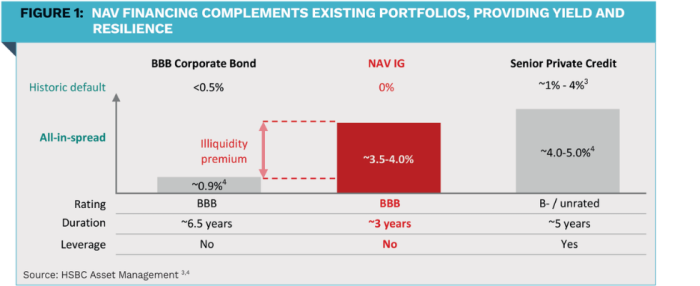
This positions NAV finance strategies as a potentially compelling proposition for investors requiring a sizeable IG-rated allocation or within asset-backed financing portfolios, capturing the illiquidity premium in an efficient format, without extending duration.
High-quality credit
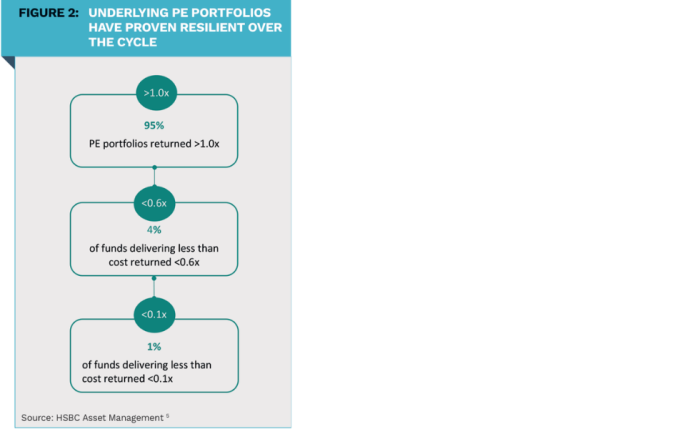
The combination of modest economic growth and increased macro and interest rate volatility tends to lead to greater investor focus on asset classes with robust credit protections and proven resilience over the economic cycle.
NAV facilities structured as senior secured credit contain protections that are cumulative rather than reliant on any single feature. Loan-to-value is typically in the 10-15% range, reducing impairment risk and creating alignment with equity owners. Lending is cross-collateralised across diversified, seasoned and performing asset portfolios, with no single asset exposure. Creditor-friendly waterfalls are designed to ensure priority access to cashflows and repayment ahead of distributions, while covenant packages combine loan-to-value tests, diversification requirements and cash sweep mechanisms.
Institutionalisation of NAV finance
The combination of enhanced disclosure standards and rating agency participation have helped to transform NAV finance into a mainstream institutional asset class.
Governance has developed as quickly as the market itself. In July 2024, the ILPA published a five-part guidance on NAV based facilities, developed with member LPs and in consultation with GPs, lenders, law firms and rating agencies. It sets clear expectations for disclosure of leverage, its cost, and transparency with regard to the use of proceeds.
Sophisticated LPs consider the use of NAV finance in their fund investments, and this guidance gives all stakeholders a common reference point. It also helps to address a question often asked of the product: IG NAV loans are not a mechanism for funding dividends or carry, and are typically focused on portfolio growth financing.
In parallel, the major credit rating agencies have published frameworks for NAV facilities, and senior secured transactions are increasingly rated investment grade. For insurers, an investment-grade rating at three-to-four-year duration is capital efficient under Solvency II, while the floating-rate nature of the loans helps to limit volatility.
Outlook
NAV finance is expected to establish itself as a key component of many private equity fund capital structures. It is a distinct exposure, driven by aggregate portfolio value and structural protections, supporting its role as a resilient diversifier within institutional private credit and asset-backed financing portfolio allocations. NAV finance provides an opportunity to channel institutional capital into a part of the real economy that remains underserved.
|
SUMMARY NAV finance is evolving into a mainstream institutional asset class. NAV finance combines potentially attractive risk adjusted returns, robust structural protections and increasingly established governance standards. By providing capital to support growth and value creation within private market portfolios, NAV finance can help channel institutional capital into the real economy. As adoption broadens and the market matures, NAV finance is well positioned to become a core component of private credit and asset-backed finance allocations, offering investors diversification and resilience. |
1. ILPA guidance published July 2024
2. ILPA guidance published July 2024
3. L7Y average defaults (excluding and including Selected Defaults) – Source: S&P Global Ratings, July 2025
4. Bloomberg (EUR BBB Composite BVAL Index), Middle Market Leveraged Finance Report – Q1 2026 (Capstone Partners).
5. Preqin 1995 -2023 data
Read the full article in the online magazine