
Generations in dialogue: No generational differences
This interview was originally written in Dutch. This is an English translation
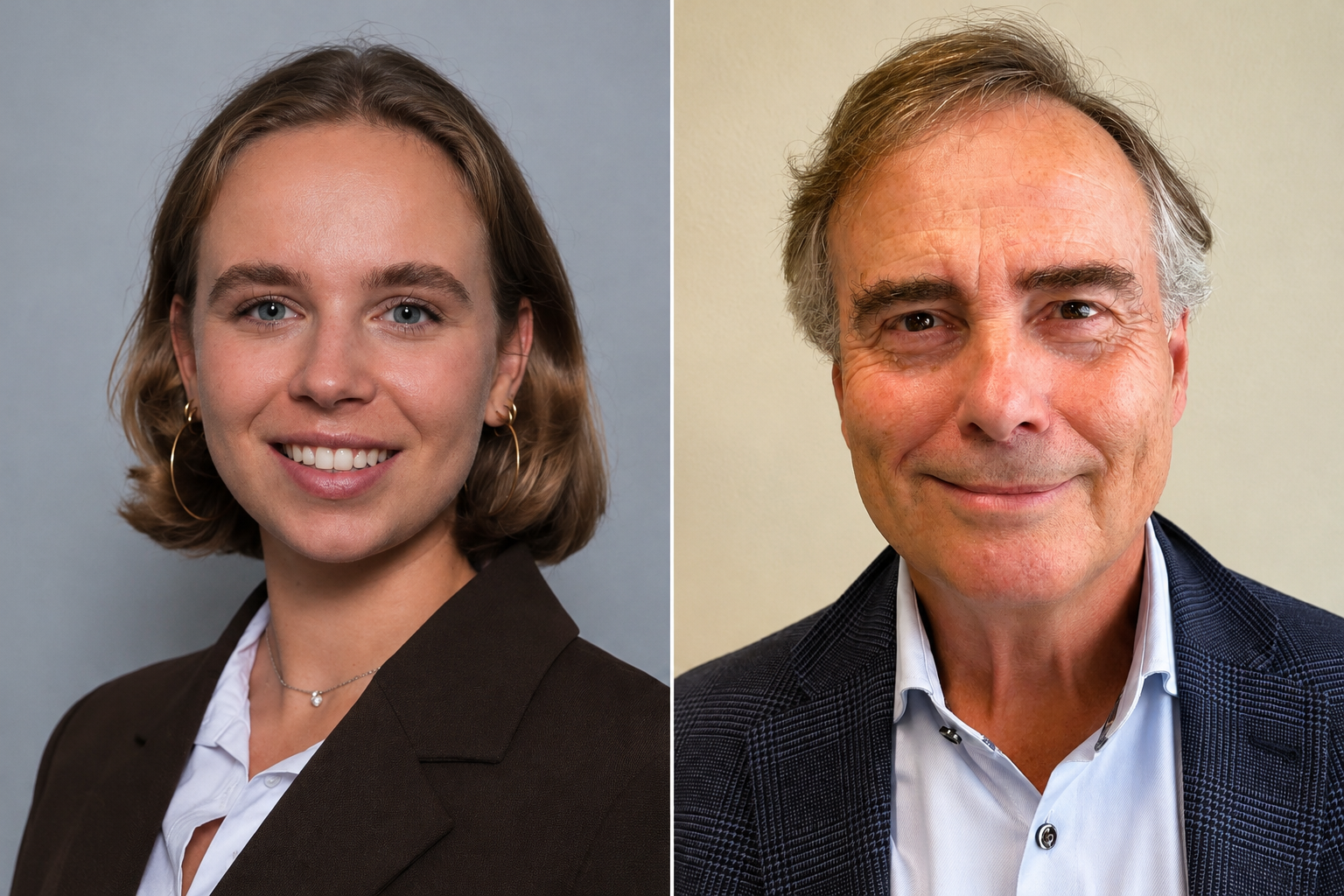
How do different generations view their work and the sector? Whilst Suze Kroon, an asset manager at Wealth Management Partners, is just starting out on her career, Maarten Kneepkens, a fiduciary manager at Van Lanschot Kempen, has many years of experience under his belt. Together, they reflect on their ambitions, experiences and vision for the profession. And what do they find? Their perspectives are remarkably similar
By our editorial team
What do you think is most important: growth, balance or purpose? And why?
Suze Kroon: ‘At the moment, growth is my top priority. I’m still at the start of my career and my ambition is to learn and discover as much as possible. That really energises me. Precisely because the financial sector is so broad and complex, I try to gain as much experience as possible and consciously seize opportunities.
However, meaning also plays an important role for me. The financial sector is often seen as a world of figures and returns, but ultimately it’s about where capital ends up. The proper allocation of capital is essential for economic progress. Entrepreneurs, innovative companies and new ideas need resources and time to grow further and make an impact.
Maarten Kneepkens: ‘I, too, choose growth. My work has always meant a great deal to me, but for me it was (and still is) more about the journey than the destination. So I choose growth, and for me that never stops. I’ve always said ‘yes’ to everything, with the idea that you learn from trial and error. But doing something for the first time always feels special to me. In our profession, too, there have been so many developments that you never tire of it. Growth is, of course, also the source of all returns in investing. So that fits in perfectly with the pursuit of personal growth.’
Which decision or moment in your careers has shaped you the most?
Kneepkens: ‘People like to see meaning in random events, and I’m no different. Looking ahead, at the time, I think it was all just coincidence, but looking back, I mainly see a pattern of small decisions. I opted for a broad degree programme and, within that, for the most academic specialisation; I chose to write my dissertation whilst on a work placement, and even before I graduated I was a macroeconomic analyst at the NMB’s securities firm. So, looking back, it was that dissertation. But there was no pre-planned strategy behind it.
I’ve always continued to work in the securities world, in a variety of roles. For the last twelve years, that’s been as a fiduciary manager for social organisations. I do think that’s the best role. Here, too, I find my favourite combination of subject-matter expertise and commercial service provision. But how did I end up in this role? If I’d known how much I’d enjoy it, I’d have taken a shorter route.
Technology can make processes more efficient, but trust, empathy and personal relationships remain the preserve of human interaction.
Kroon: ‘One of the most important lessons in my career so far is that growth often requires making conscious choices. At a certain point, I was given the opportunity to take a new step. I deliberately chose an environment where I could learn more quickly and take on greater responsibility. That’s how I ended up at Wealth Management Partners, in a role where I’m given a lot of responsibility and am challenged on a daily basis. As a result, I’ve learnt how important it is to remain curious, recognise opportunities and, sometimes, consciously choose a new direction.’
Which skills will be indispensable for the profession in the future?
Kroon: ‘It is becoming increasingly clear that AI is having a transformative impact on our profession. Information is available faster than ever, and decisions are increasingly supported by technology. That is why it is becoming ever more important to be able to work effectively with AI and to ask the right questions.
At the same time, I believe that it is precisely the human side of our profession that is gaining in value. Technology can make processes more efficient, but trust, empathy and personal relationships remain the preserve of human interaction. Professionals who know how to combine AI with genuine attention to clients will stand out. Moreover, as technology takes work off our hands, it creates more scope for personal contact.’
Which skills ultimately proved to be far more important to the profession than previously thought?
Kneepkens: ‘Without a doubt, the “soft” skills, with interest, listening and empathy at the forefront. If investment services – the sector my profession falls under – are anything, it is precisely that: service. It begins and ends with a good relationship with your clients or potential clients. I had expected it to be primarily a technical profession, where good models and data, well-thought-out processes and technical knowledge would be the deciding factors. Now, those are indeed very important, but many firms have that part of the job well under control. And to really make a difference, you can’t do without empathy and a genuine desire to understand your clients and their challenges. In a way, I find that a shame, because I also find the ever-advancing technical development of the profession very interesting.’
What do you think is the biggest misconception about your own generation in the workplace?
Kroon: ‘The biggest misconception is that Gen Z lacks a drive to perform. Many people from my generation are, in fact, very ambitious and willing to work hard, but they view work differently from previous generations.
I think it’s important that my work adds value and that there’s scope for personal initiative and development. That’s sometimes seen as demanding, but I think it’s actually a strength. People who think critically about why they do something are often highly motivated to contribute and innovate. That fosters creativity and innovation and actually helps a company move forward.’
Kneepkens: ‘If I had to mention one thing about my generation, it might be that I often hear that my generation has already experienced everything the financial markets have to offer. And that really isn’t the case. What’s happening now is also new. What it means is unknown, how it will end is unknown, and there’s no rule of thumb that can offer any certainty.
Other than that, I can’t think of any misconceptions. I think they understand us perfectly well. A lot has changed in the financial sector, and consequently in all organisations. If you’ve been through all those changes and still remain in this sector, then there must be a spark burning inside you somewhere. And that is certainly recognised.’
What have you learnt from working with other generations, and what is the biggest challenge in that regard?
Kneepkens: ‘What I’ve learnt is that younger generations have the same approach that I myself had. They don’t assume they still have anything to learn. Even if it’s new, they assume they can do it. I recognise that, and I really appreciate it.
My generation joined the sector just as the financial sector was beginning a massive upswing. As a result, the generation before us was twenty years older. That’s different now. The sector has continued to recruit young people, which is why I work with people of all ages. I don’t really see any generational differences. I see greater differences between individual colleagues.
And throughout my career, I’ve seen far greater (cultural) differences between companies. That was the main challenge for me: finding the culture that suits me. Working together – including with other generations – is then much easier.
Of course, every generation brings new technical skills. They build their models more easily, and using different programmes. I’ve tried to keep up with that – learning new things again. That was easiest when I could apply it straight away in my work. That provides both motivation and a return on investment. Without younger colleagues, I think that would really become a challenge.’
I’ve always said ‘yes’ to everything, on the basis that you learn from trial and error
Kroon: ‘I enjoy working with colleagues from different generations and often find that the age difference is less noticeable than you might expect. What I’ve learnt above all is just how valuable experience is, for example when having conversations with clients. You can prepare thoroughly in terms of content, but there are many situations you only learn to recognise by experiencing them more often. That’s why I like to observe more experienced colleagues to see how they handle such conversations.
In my view, the biggest challenge for older generations lies in dealing with change. If you’ve been used to working in a certain way for years, it takes time to embrace new ways of working. Younger generations are often more flexible in this regard, whilst experienced colleagues bring valuable knowledge and context to the table.
And what have older generations learnt from me? That we don’t always need a paper brochure. Although it can sometimes still come in surprisingly handy… for example, if you want to get rid of your chewing gum.’
|
Suze Kroon Suze Kroon is an Asset Manager at Wealth Management Partners. After completing her studies, she joined Van Lanschot Kempen in 2024 as an Investment Advice Client Manager, where she laid the foundations for her further development within the financial sector. She now advises high-net-worth individuals, entrepreneurs and families on matters relating to their wealth and investments. She has a particular interest in financial education, women and investing, and advising entrepreneurs. |
|
Maarten Kneepkens Maarten Kneepkens is a Senior Fiduciary Manager at Van Lanschot Kempen. Since 2012, he has specialised in fiduciary management for social organisations. After completing his degree in Monetary Economics, Kneepkens began his career as a macro-economist at NMB Bank, and later managed three investment funds on behalf of NMB Bank and the NMB Postbank Group. In 1991, he moved into private wealth management, first at ING subsidiary CenE Bankiers and, from 2004, at Van Lanschot Kempen. |
Read the report in the digital magazine